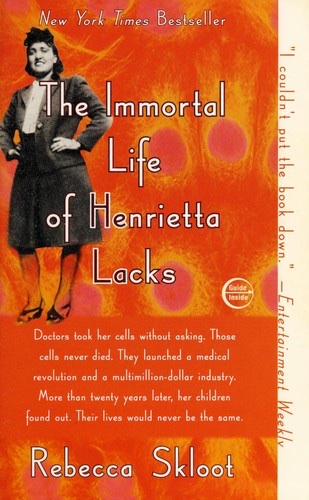
Cover of The Immortal Life of Henrietta Lacks

The Immortal Life of Henrietta Lacks

Rebecca Skloot

4 ideas

  1. Henrietta Lacks's cells become HeLa

    In 1951, surgeon Howard Jones took a biopsy of Henrietta Lacks's cervical tumor at Johns Hopkins, a public-ward hospital that treated poor Black patients. Researcher George Gey found that her cells, unlike any before them, kept dividing indefinitely in culture. The HeLa line was then used to develop the polio vaccine and to advance gene mapping and cancer research, while Lacks died at 31 and her family learned of the cells only in the 1970s, still unable to afford health insurance.

  2. Tissue leaves the body, rights stay behind

    Researchers and companies can therefore patent and profit from products derived from it while the source has no claim. In Moore v. Regents of the University of California (1990), the California Supreme Court ruled that John Moore had no property right in the cell line made from his spleen, even though it was commercialized.

  3. Scientific benefit and personal harm coexist

    The same act can be a triumph for medicine and a lasting wound for a family. Seeing both at once means counting who bore the cost, who received the credit, and who was never told, not only what was discovered. HeLa's value to science does not cancel the family's exclusion, and the family's grievance does not erase the value.

  4. Institutional distrust built by unexplained science

    When researchers take samples, publish identifying details, or run follow-up tests without explaining what they are doing, subjects fill the gap with fear drawn from real history such as the Tuskegee syphilis study. Deborah Lacks believed her mother was still somehow alive and suffering inside labs, because scientists had drawn the family's blood for HeLa research without explaining it. Withholding explanation from subjects damages trust in medicine beyond the harm of the original act.

Save and mark ideas in the app