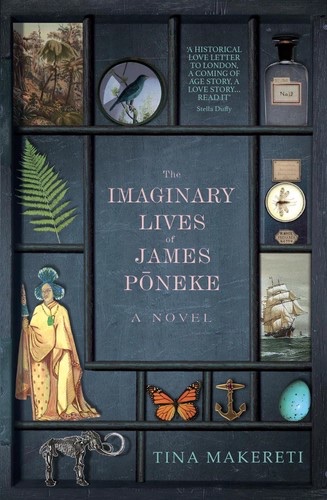
Cover of The Imaginary Lives of James Pōneke

The Imaginary Lives of James Pōneke

Tina Makereti

4 ideas

  1. Māori orphan exhibited as London's living specimen

    James Pōneke, a young Māori boy orphaned by intertribal war and raised in Pākehā mission and settler households, sails to London in the 1840s with an English artist whose paintings of New Zealand are to be shown to the public. There he is placed on stage beside the paintings and artefacts as a 'living specimen' of the native, performing for paying Victorian crowds while also moving through the city as a curious, English-speaking young man. The case shows one person being at once a guest, a worker, an exhibit and a tourist in the imperial capital.

  2. The exhibited subject is also watching back

    The display frame assumes a one-way gaze: the audience looks, and the specimen is looked at. Pōneke reverses this by studying the crowds as closely as they study him, cataloguing their clothes, manners and cruelties the way an ethnographer would. This makes visible that the observers are themselves a strange people whose customs could be recorded, and that the 'object' has an inner life the spectacle cannot capture.

  3. Spectacle manufactures the savage it claims to reveal

    The exhibition presents itself as showing a natural type, yet it requires staging: costume, carving, posed ferocity and scripted performances such as haka for an audience that has paid for a thrill. The 'savage' on display is a product co-created by showman, artist and crowd expectation, and a man who speaks English and reads the Bible has to be made less familiar to fit it. Authenticity in colonial display is therefore a performance demanded of the displayed, not a fact about them.

  4. Narrating oneself to a future descendant

    Pōneke tells his story in the first person, addressing a 'you' in a future generation instead of the Victorian audience that paid to look at him. Choosing the listener shifts authority over the account: the life that was framed by others as specimen and curiosity is re-framed by the subject as testimony and inheritance. Self-narration to one's own people becomes a way of taking back control of an image that others once owned.

Save and mark ideas in the app