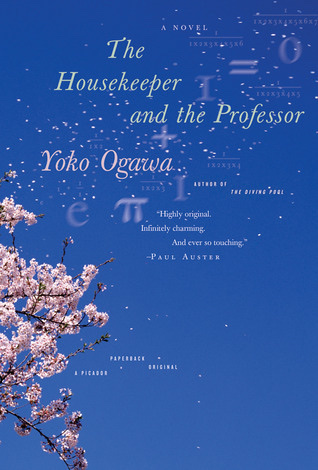
Cover of The Housekeeper and the Professor

The Housekeeper and the Professor

Japan · 1975–2003

4 ideas

Buy on Amazon

In Japan, a housekeeper begins work for a mathematician whose new memories last only eighty minutes. Her ten-year-old son, whom he calls Root, becomes part of their days. Yoko Ogawa's novel follows the connections the three make through numbers, even as each visit must begin anew.

  1. A family built around eighty-minute memory

    A retired number theorist, head-injured in a 1975 car accident, retains new memories for only eighty minutes. Each morning his newly assigned housekeeper is a stranger, so he greets her by asking her shoe size or phone number and reports its mathematical properties (24 is 4 factorial; her phone number equals the count of primes below 100 million). He nicknames her ten-year-old son Root for his flat head, and the three form a family-like bond that he must be reintroduced to daily through notes pinned to his suit.

  2. Notes pinned on as external memory

    The Professor pins handwritten notes to his suit, including 'My memory lasts only 80 minutes' and a sketch of the housekeeper labeled 'new housekeeper.' Each morning the notes stand in for recall, so the relationship persists in the artifacts and in the people who remember him, not in his own mind. Continuity of a bond can be carried entirely by one side plus a written record, with the other side re-entering it fresh every day.

  3. Mundane numbers hide intimate connections

    The Professor treats every ordinary number as a potential bearer of hidden structure and meaning. The housekeeper's birthday, 220, and the number engraved on his university prize watch, 284, turn out to be amicable numbers, each the sum of the other's proper divisors, a mathematical echo of their friendship. Looking for the properties of a number converts arbitrary facts about a person into a point of real connection.

  4. Eternal mathematical truth consoles impermanent memory

    For a man whose own life erases itself every eighty minutes, mathematics offers truths that exist outside time and do not depend on anyone remembering them. Euler's identity, e^(iπ) + 1 = 0, which he writes down to end a family quarrel, is presented as invisible, permanent order beneath a fleeting world. The characters protect what fades, such as hiding that his Hanshin Tigers hero Enatsu, who wore the perfect number 28, has long retired, while leaning on what cannot fade.

Save ideas and give them a thumbs up or down in the app