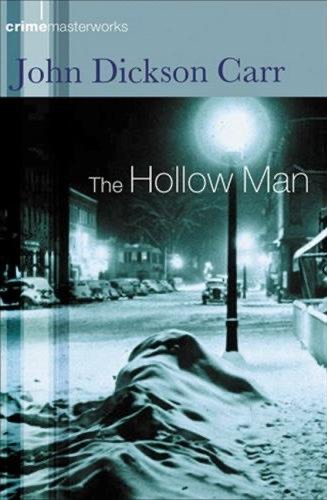
Cover of The Hollow Man

The Hollow Man

John Dickson Carr

3 ideas

  1. Grimaud's sealed study and Cagliostro Street

    Professor Charles Grimaud is shot in his London study after a masked visitor enters, yet witnesses watching the only door see no one leave and fresh snow outside shows no footprints. Soon afterward his estranged brother, the conjurer Pierre Fley, is shot at close range in the middle of snowy Cagliostro Street, and bystanders see no attacker and find no tracks. Dr Gideon Fell shows that both impossibilities come from a false assumption about when, where and by whom the shots were fired: the two men were locked in a single deadly quarrel, so the apparent victim of one crime was the killer in the other.

  2. Improbability is not a valid objection

    Fell argues that calling a solution "improbable" is not a real criticism, because a crime becomes interesting precisely by departing from the ordinary. What matters is whether the explanation is possible and fits every observed fact. A reader's sense of likelihood is shaped by everyday experience and is a poor test for an event that is exceptional by definition.

  3. Impossibilities hide a wrongly fixed assumption

    When an event seems physically impossible, the useful question is not "how was the impossible done?" but "which fact have I treated as certain that is actually an inference?" Usually that fact is the time something happened, the place it happened, or who was the actor and who the victim. Loosening that one assumption turns the impossible into the merely clever.

Save and mark ideas in the app