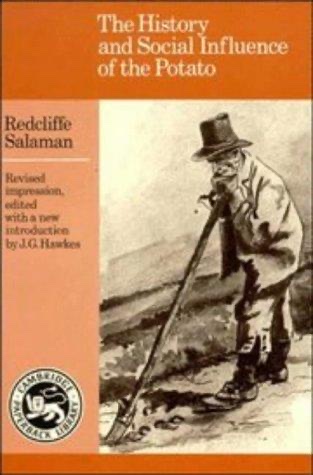
Cover of The History and Social Influence of the Potato

The History and Social Influence of the Potato

Redcliffe Salaman

4 ideas

  1. Irish famine as monoculture system failure

    By the 1840s roughly three million Irish poor lived almost entirely on potatoes, largely a single clonal variety (the Lumper), grown on tiny conacre plots rented in exchange for labour. Salaman treats the famine not as a natural accident but as the predictable collapse of a social system built on one crop.

  2. Cheap staple crops enable labour exploitation

    Because an acre of potatoes could feed a family on a scrap of marginal land, the crop let landlords and employers pay subsistence-level wages and subdivide holdings ever smaller. The potato's efficiency did not raise living standards; it lowered the floor at which labourers could survive, allowing population to rise while wealth was extracted by others. A food that makes survival cheap can become the instrument that keeps people poor.

  3. Clonal propagation concentrates catastrophic risk

    Potatoes are grown from tubers, not seed, so a whole region's crop can be genetically identical copies of one plant. This makes yields uniform and predictable in good years but means a single pathogen able to attack that genotype can wipe out everything at once. The efficiency gained from uniformity is paid for with fragility against novel shocks.

  4. Food as a social institution, not commodity

    Salaman reads the history of a crop by asking what forms of land tenure, family size, labour relations and state power it made possible, rather than treating it as a mere foodstuff. Seen this way, the adoption of a staple reshapes demography and hierarchy, from Inca terraced agriculture to European peasant economies. Tracing how a society feeds itself reveals its structures of dependence and control.

Save and mark ideas in the app