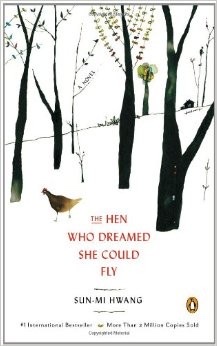
Cover of The Hen Who Dreamed She Could Fly

The Hen Who Dreamed She Could Fly

Hwang Sun-mi

4 ideas

  1. Culled hen raises an abandoned duck egg

    Sprout, a battery hen who has stopped laying, is culled and thrown into a pit of dead hens. She survives, is shunned by the barnyard, and finds an unguarded egg in a briar patch whose white-duck mother the weasel has killed. She hatches it while the wild mallard father, Straggler, guards her until the weasel kills him too. She then raises the duckling, Greentop, until he learns to fly and leaves with a migrating flock of wild ducks.

  2. Self-naming as the first act of freedom

    The name holds the future she wants, to hatch and raise a life, and it sets her apart from the farm's categories before she has physically left them. Choosing your own name comes before, and makes possible, the refusal of the role a system assigns you.

  3. Motherhood is made by choice, not by species

    The book holds that a parent is whoever chooses to sit on the egg and see the child through, not whoever shares its blood or kind. Sprout's success as a mother is measured by her willingness to let Greentop leave for a flock and a sky she cannot enter. Real parenting ends in the child's departure into a life that belongs to its own nature, not the parent's.

  4. Seeing the predator as another mother

    At the end, Sprout learns that the one-eyed weasel who killed Straggler is a starving mother with young of her own. Weakened, Sprout offers herself to be eaten so the weasel's babies can live. Seeing the enemy as someone bound by the same duty to feed her young turns hatred into recognition, and death into a final act of giving.

Save and mark ideas in the app