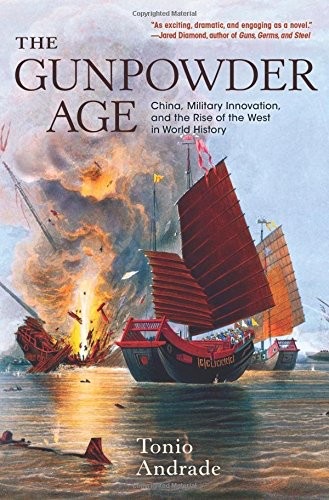
Cover of The Gunpowder Age

The Gunpowder Age

Tonio Andrade

6 ideas

  1. Military divergence came late, not early

    China's military capacity stayed roughly equal to Europe's until about 1700 and fell clearly behind only after about 1760. Before that, Ming and Qing armies used and improved firearms as well as Europeans did. The gap that showed in the Opium Wars was recent, not a deep civilizational one going back to the Song or Ming.

  2. Warfare-intensity drives military innovation

    Gunpowder technology advances fastest when states face constant, evenly matched warfare that punishes falling behind. The Song-Jin-Yuan wars and the late Ming conflicts produced rapid Chinese innovation. Europe's continuous interstate competition kept its innovation going.

  3. The Great Qing Peace

    After the Qing conquered the Zunghars around 1760, China faced no serious peer rival for nearly eighty years. Its military had no reason to modernize, so it stagnated while Europe's Napoleonic-era arms race sped up. Military backwardness can come from long security, not from cultural or institutional incapacity.

  4. Koxinga defeats the Dutch at Taiwan

    In 1661–62 the Ming loyalist Zheng Chenggong besieged the Dutch fortress Zeelandia and forced its surrender. He succeeded by adapting European siege methods and exploiting a Dutch defector's advice. The case shows Chinese forces beating a European military power in the seventeenth century by quickly absorbing its techniques.

  5. Hybridization over one-way diffusion

    Gunpowder technology moved in many directions, not simply from a superior West to a backward East. Ming armies adopted Portuguese breech-loading cannons and Dutch-style culverins and blended them with their own tactics, and Europeans had first built on Chinese gunpowder. Military advantage came from how fast each side learned and recombined foreign techniques.

  6. Ming volley-fire musket drill

    Qi Jiguang and other Ming commanders developed rotating volley fire, in which ranks of gunners fire in turn to keep up continuous shooting. They did this independently of, or before, the European 'countermarch' credited to the Dutch reforms of the 1590s. So the drill-based 'military revolution' was not a uniquely European invention.

Save and mark ideas in the app