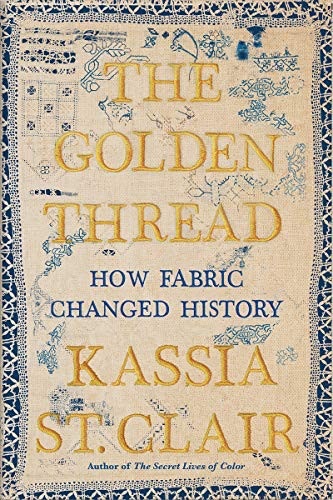
Cover of The Golden Thread

The Golden Thread

Kassia St Clair

5 ideas

  1. Textiles as invisible foundational technology

    Before industrial machinery, producing cloth, especially spinning thread by hand, consumed a vast share of human labour, much of it done by women, so fabric was among the costliest goods a society made. Because cloth is soft, perishable and domestic, historians have filed it under craft or fashion rather than technology. Reading history through textiles shows that fibre supply and cloth production shaped trade routes, empires, labour systems and what exploration was physically possible.

  2. The Viking sail outweighed the ship

    On some estimates that is more labour than building the wooden hull. Seaborne Viking expansion therefore rested on an enormous, largely female textile workforce on land, not only on boat-building and warrior culture.

  3. Bra makers stitched the Apollo spacesuits

    The suits worn on the Moon in 1969 were made by ILC, a company linked to the Playtex girdle and bra business. They beat established military contractors for the contract. Seamstresses sewed the many-layered suits by hand to extremely fine tolerances, because one faulty seam could kill an astronaut. The episode shows that frontier technology can depend on tacit garment-making skill that engineering firms lacked.

  4. Silk functioned as money and diplomacy

    In imperial China, silk was used as currency, to pay soldiers and taxes, and as tribute paid to nomadic neighbours to keep the peace. Silk therefore flowed outward along trade routes as a store of value, not just as a luxury. The Roman appetite for imported silk was criticised by some Romans as a drain of precious metals to the East.

  5. Nylon stocking riots after the war

    DuPont launched nylon stockings in 1939-40 to huge demand. Wartime diversion of nylon into parachutes and other military goods then created severe shortages. The episode shows how a synthetic fibre turned into a mass necessity within a few years, and how supply shocks to an everyday textile can provoke public disorder.

Save and mark ideas in the app