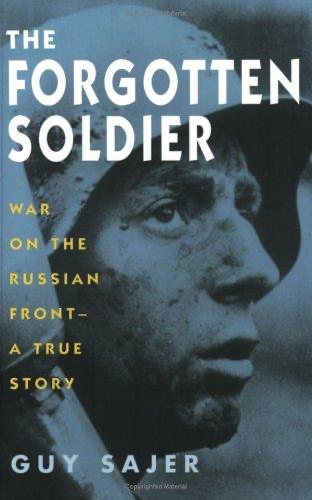
Cover of The Forgotten Soldier

The Forgotten Soldier

Guy Sajer

4 ideas

  1. Alsatian Teenager Through Wehrmacht's Collapse

    Guy Sajer, a French-German Alsatian youth, joined the Wehrmacht in 1942, served first as a supply driver and then as an infantryman in the elite Grossdeutschland division. He went through the winter supply runs in Russia, the fighting around Kharkov and Belgorod, the desperate crossing of the Dnieper, and the retreat to the Memel pocket, before surrendering in 1945 and later serving in the French army. Historians dispute some of the book's details, but veterans have defended its texture, which makes it both a primary case and a caution about the reliability of memoir.

  2. War Seen From the Body Upward

    To the frontline infantryman, war is almost entirely hunger, cold, lice, exhaustion, and the next few meters of ground, and he knows little about operations, maps, or objectives. Viewing a war this way changes what its central events are. A frozen supply road or a missing ration matters more to the soldier than a strategic decision, and a collapse of an army is lived as the disintegration of routines, one lost comrade at a time.

  3. Men Fight for Comrades, Not Causes

    Sajer shows soldiers holding together under hopeless conditions because of loyalty to the few men around them and to the unit's identity, not because of ideology or belief in victory. Officers like his company commander Wesreidau kept men fighting by treating them as a bonded community with shared honor. Cohesion let the unit endure long after its purpose had become meaningless, and this made the soldiers capable of both extraordinary resilience and complicity in a lost, criminal cause.

  4. The Unreceivable Experience of the Returning Soldier

    Some experiences cannot be transmitted to people who were not there. Civilians lack the frame to hear them, and the veteran's side lost or is morally suspect, so the listeners want the memories to go away. The survivor is left carrying a past that has no audience, and he becomes 'forgotten' in the sense that his experience cannot be socially integrated, not only in the sense that he is ignored. Sajer, a Frenchman who fought for Germany, returns to a France where his war cannot be spoken about at all.

Save and mark ideas in the app