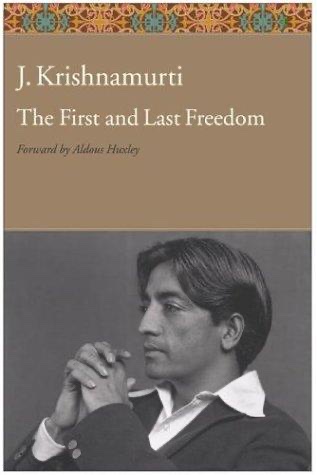
Cover of The First and Last Freedom

The First and Last Freedom

Jiddu Krishnamurti

6 ideas

  1. The observer is the observed

    The thinker who watches thoughts is not separate from them; thought creates the thinker to gain a sense of permanence and control. As long as a separate observer seems to exist, it tries to change what it sees, and that effort is conflict. When the division ends, there is no one left to manage the experience, and the conflict stops.

  2. Choiceless awareness without condemnation or justification

    Choiceless awareness means watching whatever arises in the mind without judging it, justifying it, or picking which parts to keep. Naming and judging a feeling puts it inside an old framework, so the reaction is really to memory and not to the fact in front of you. Watching without choosing lets the fact show itself fully, and the watching itself changes it.

  3. Method and technique produce conditioning, not freedom

    A method toward freedom or peace shapes the mind into the pattern the method prescribes, so what comes out is a conditioned result and not freedom. Freedom has to be present at the start, not at the end, because the means decides the end. Practicing discipline to become free only makes the mind skilled at conforming.

  4. Following authority destroys self-understanding

    When you accept a guru, a tradition, or an expert as the authority on your inner life, you hand over the direct observation that alone brings understanding. People follow authorities because they want certainty and security, so the following is itself driven by fear. Truth cannot be passed from one person to another; each person has to find it by watching themselves.

  5. Becoming as the root of psychological conflict

    The mind's constant effort to become something other than what it is, whether more virtuous, more calm, or more successful, sets up a gap between 'what is' and 'what should be.' Ideals do not help change; they postpone it, because they turn attention away from the actual fact. Seeing 'what is' fully, with no ideal in the way, is the only transformation that is not just a modified continuation of the self.

  6. Individual transformation precedes social change

    Society is the relationship between individuals projected outward, so its conflict, greed, and violence mirror the inner state of each person. Political or economic systems reorganize these patterns without dissolving them, because the same conditioned minds run the new structures. Real change in the world has to start as a basic change in the individual's relationship to their own mind.

Save and mark ideas in the app