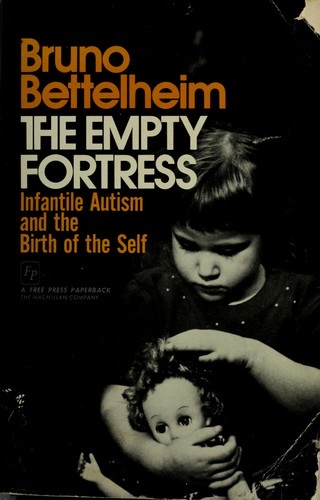
Cover of The Empty Fortress

The Empty Fortress

Bruno Bettelheim

6 ideas

  1. Parental coldness as autism's cause

    Bettelheim argued that autism is a child's withdrawal in response to parents, especially mothers, who unconsciously wished the child did not exist and gave no warm, responsive care. This became the 'refrigerator mother' theory. It has been thoroughly discredited: autism is a neurodevelopmental condition with strong genetic contributions, and the theory caused lasting harm by blaming parents.

  2. Autism as a concentration camp response

    Drawing on his own internment at Dachau and Buchenwald, Bettelheim equated the autistic child's inner world with that of a prisoner in an extreme situation. On this view, the infant experiences its surroundings as total threat and gives up acting on the world, much as prisoners he saw became apathetic 'Muselmänner'. The analogy recasts developmental difference as trauma-driven despair, and that framing is where his causal errors began.

  3. The self as an empty fortress

    Bettelheim pictured the autistic child as having built rigid defenses, such as silence, ritual, and sameness, around a self that never fully formed. Selfhood, he held, forms only when an infant's own actions get a response from others, so a child who meets no response stays hollow.

  4. Joey, the boy who was a machine

    Joey believed he was run by machines and could not eat, sleep, or breathe without imaginary wires, motors, and carburetors. Bettelheim read this as a defense: a boy who felt no human care made himself mechanical so he could not be hurt, and he became human again through consistent attention from staff. The case is vivid, but later investigation showed Bettelheim's accounts of cures and methods were unreliable and at times invented.

  5. Milieu therapy through a total environment

    At the Orthogenic School, children were removed from their families and placed in an environment where staff were meant to meet every need without demands, so the child could discover that its actions have effects. Therapy was the whole daily milieu, not scheduled sessions, and it rested on the premise that separation from parents was itself curative. Former residents later reported that Bettelheim hit them and ruled through fear, and his reported recovery rates were never verified.

  6. Feral children were autistic, not wild

    Bettelheim reexamined cases of 'wolf children' such as Amala and Kamala and argued they were not raised by animals. In his reading, they were autistic children who had been abandoned, and their animal-like behavior was misread as proof of wild upbringing. He turned the legend around: extreme neglect by humans, not care by animals, explained the children's condition.

Save and mark ideas in the app