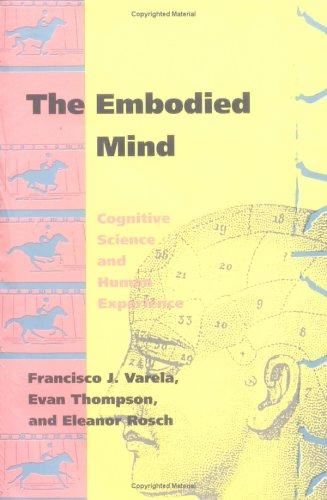
Cover of The Embodied Mind

The Embodied Mind

Francisco Varela, Evan Thompson and Eleanor Rosch

6 ideas

  1. Enaction: cognition as structural coupling

    Cognition is not the representation of a pregiven world by a pregiven mind but the enactment of a world through the history of a body's sensorimotor coupling with its environment. Perception consists of perceptually guided action, and cognitive structures emerge from the recurrent sensorimotor patterns that let action be guided perceptually. Organism and world specify each other, so neither is the fixed starting point.

  2. Color vision as enacted, not detected

    Color is not a property waiting in the world to be recovered, since perceived color does not map onto reflectance. Perceived color depends on neural comparisons across cone types and surrounding context, and it varies across species with different numbers of color channels. Color is co-determined by the structure of an animal's visual system and its ecological history, so it is neither purely out there nor purely in the head.

  3. Three stages of cognitive science

    Cognitive science has passed through three paradigms. Cognitivism treats cognition as rule-based manipulation of symbols. Connectionism treats it as the emergence of global states in networks of simple components. Enaction treats it as embodied action that brings forth a world, and each stage progressively loosens the assumption that mind represents an independent, pregiven reality.

  4. Mindfulness as disciplined first-person method

    Cognitive science studies experience without any rigorous method for examining experience itself, which leaves a gap between scientific theories of mind and lived experience. Mindfulness/awareness meditation trains attention to observe moment-to-moment arising of mental events, supplying a disciplined, repeatable first-person method that can inform and constrain scientific accounts.

  5. Selfless mind: self without an owner

    Careful observation of experience finds no unified, enduring self, only a flow of momentary aggregates (form, feeling, perception, dispositions, consciousness) arising and passing. Cognitive science converges on the same point: cognition emerges from distributed, decentralized processes with no central controller. The felt sense of a self is an emergent pattern, not an entity behind the processes.

  6. Groundlessness: a middle way between extremes

    Recognizing that neither mind nor world has fixed, independent foundations provokes anxious grasping, either toward objectivism (the world grounds us) or subjectivism/nihilism (the mind grounds us, or nothing does). Madhyamaka's concept of emptiness, or codependent arising, dissolves the demand for any ground, so groundlessness becomes the condition for open, ethical, compassionate action rather than a cause of despair.

Save and mark ideas in the app