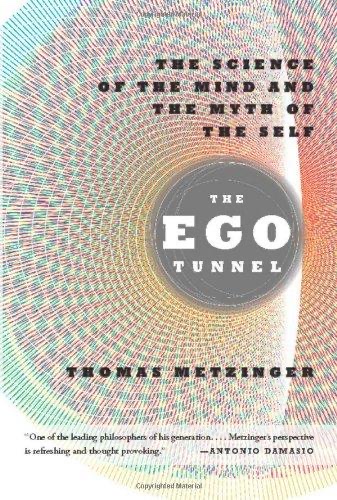
Cover of The Ego Tunnel

The Ego Tunnel

Thomas Metzinger

6 ideas

  1. Phenomenal transparency hides the model itself

    A representation is transparent when the system cannot experience it as a representation; it sees only the content, never the medium. Because the brain's self-model is transparent in this sense, we do not experience ourselves as having a model of a self; we simply experience being a self. The feeling of direct, unmediated selfhood is produced by the system's inability to detect its own modeling processes.

  2. No one has ever been a self

    There is no enduring, substantial self anywhere in the world; there are only self-models generated by brains, plus the experience of being someone that those models produce. The self is the content of a transparent self-model, not an entity behind it. We are not the thing the model depicts. We are the ongoing process of self-modeling that cannot recognize itself as such.

  3. The Ego Tunnel of conscious experience

    Conscious experience is a real-time virtual reality the brain builds: a low-dimensional, highly selective inner simulation of the world with a self-model at its center. We live inside this tunnel and take it for direct contact with reality, even though it is an online model tuned for survival rather than for accuracy. The tunnel has no visible walls because its construction is transparent to the one inside it.

  4. Rubber hand illusion relocates body ownership

    When a person's hidden real hand and a visible rubber hand are stroked at the same time, the person begins to feel the touch in the rubber hand and experiences it as their own. Synchronous visual and tactile input is enough to make the brain fold a foreign object into its body model. This shows that the sense of owning a body is a flexible, constructed feature of the self-model rather than a fixed fact.

  5. Induced out-of-body experiences through virtual reality

    In experiments using head-mounted displays, participants who watched a virtual body from behind while their own backs were stroked in sync came to identify with the virtual body and mislocalized their own position toward it. Along with neurological cases of out-of-body experience, these studies show that a sense of self-location and a first-person perspective can be pulled apart from the physical body. Global body identification is therefore a manipulable output of the brain's self-model.

  6. Consciousness ethics for self-models and machines

    If subjective suffering depends on a transparent self-model that owns negative states, then any system with such a model, whether biological or artificial, could suffer. Metzinger therefore argues against deliberately creating artificial self-models capable of suffering and calls for a new applied 'consciousness ethics.' That ethics would govern neurotechnology, psychoactive substances, and machine consciousness by asking which states of consciousness are worth creating or allowing.

Save and mark ideas in the app