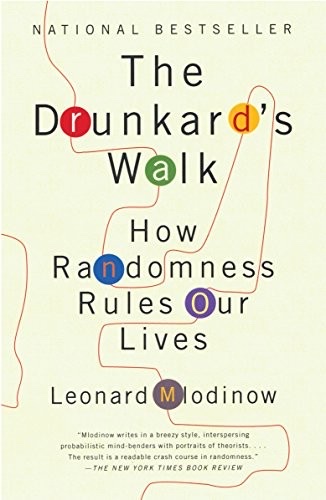
Cover of The Drunkard's Walk

The Drunkard's Walk

Leonard Mlodinow

6 ideas

  1. Sherry Lansing's firing before the hits

    Sherry Lansing ran Paramount through hits like Forrest Gump and Titanic, then was pushed out after a few years of weak box office. The films she had already greenlit then became major hits under her successor. Her firing shows how boards treat a short stretch of outcomes in a noisy, hit-driven business as a verdict on a person's skill, rewarding and punishing luck as if it were competence.

  2. Regression to the mean misread as causation

    Israeli flight instructors believed praise made cadets worse and yelling made them better. Exceptional performances are partly luck, so they tend to be followed by more average ones whatever the instructor does. Because we notice what follows our feedback, regression quietly teaches us that punishment works and reward backfires.

  3. Long winning streaks arise by chance

    Fund manager Bill Miller beat the S&P 500 fifteen years in a row and was hailed as a genius. Across thousands of managers over several decades, the odds that someone would post such a streak by chance alone were high. The right question is not how likely this person's streak is, but how likely it is that anyone in the population would produce one.

  4. Base rates dominate test accuracy

    Mlodinow tested HIV-positive, and his doctor read a 1-in-1,000 false-positive rate as meaning a 999-in-1,000 chance he was infected. Among 10,000 people from his low-risk group, only about 1 is infected but about 10 test falsely positive. So a positive result meant roughly a 1-in-11 chance of infection. Bayesian reasoning means asking what share of all positive results come from true cases, not how often the test errs.

  5. Added detail makes stories feel likelier

    In the Linda problem, people judge 'feminist bank teller' more likely than 'bank teller,' though a conjunction can never be more probable than either of its parts. Each specific detail that fits our mental picture makes a scenario feel more plausible while making it less probable. Vivid, coherent narratives are therefore a warning sign, not evidence.

  6. Conditioning on the wrong event misleads

    In the O.J. Simpson trial, the defense argued that only about 1 in 2,500 men who batter their wives go on to murder them. That figure answers the wrong question, because Nicole Brown Simpson had been murdered. Among battered women who are murdered, the batterer is the killer in most cases. Which facts a probability is conditioned on can reverse its meaning, and courts routinely confuse the chance of the evidence given innocence with the chance of innocence given the evidence.

Save and mark ideas in the app