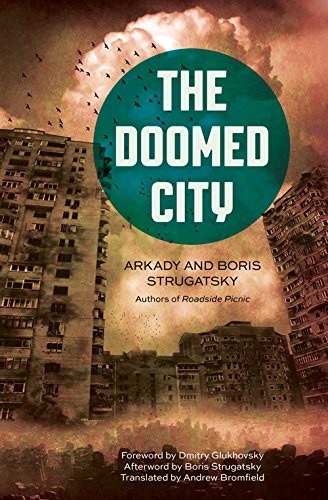
Cover of The Doomed City

The Doomed City

Arkady and Boris Strugatsky

4 ideas

  1. Voronin's Journey from Believer to Regime Official

    Andrei Voronin, a young Komsomol astronomer from 1951 Leningrad, volunteers for a walled City run by unseen Mentors, believing he is building a just society. As plagues, a baboon invasion and the sun's failures unsettle the City, a former Wehrmacht soldier, Fritz Geiger, seizes power, and Voronin becomes a privileged official of the new regime who leads an expedition north toward the Anti-City. By the end he has lost every conviction he arrived with, and a Mentor tells him he has only completed the first circle of the Experiment.

  2. The Temple of Culture Worth Serving

    Izya Katzman argues that the only thing worth serving is the Temple: the slowly accumulating body of knowledge, art and moral achievement that individuals add to across generations. It gives meaning without requiring a utopian goal or a trusted authority, because each contribution outlasts every regime. It works as a counter-purpose that survives the collapse of political faith.

  3. Idealists Without an Object Become Power's Servants

    When a committed believer loses the goal his ideology promised, his capacity for loyalty and discipline does not disappear. It gets reattached to whoever offers order and rank. Voronin's zeal for building communism turns, with little resistance, into service to Geiger's dictatorship, because the habit of believing outlived what it was belief in.

  4. Society as an Experiment With Hidden Purpose

    The City rotates citizens through random professions by lottery and subjects them to inexplicable disasters, while the Mentors never state what the Experiment is testing. Seeing a society this way shows its members as subjects who keep inventing meanings for conditions they did not design and cannot see beyond. Their political systems then read less as solutions and more as responses the experimenters are measuring.

Save and mark ideas in the app