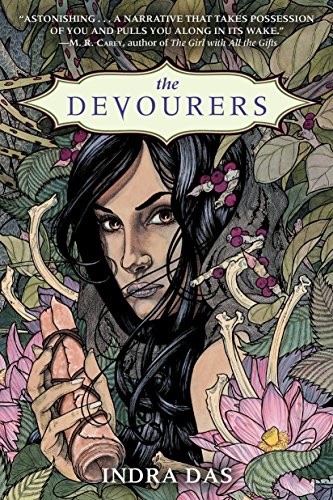
Cover of The Devourers

The Devourers

Indrapramit Das

4 ideas

  1. Cyrah and Fenrir in Mughal India

    In Mughal-era India, a young woman named Cyrah is raped and impregnated by Fenrir, a Norse-born shapeshifter who travels with a pack of predatory companions and longs to reproduce the way humans do. Cyrah refuses to remain a victim or a vessel. She follows the shapeshifters, confronts Fenrir, and demands an accounting, turning his act of possession into the start of her own pursuit and testimony. The episode shows how a predator's yearning for human intimacy is enacted as violation, and how the violated party can seize the narrative.

  2. Humans as specimens, predators as aliens

    They see themselves as a separate species and treat humans as prey, livestock, and objects of curiosity. This reverses the usual monster tale, in which the human studies the monster. Here the human becomes the studied, consumed specimen, and 'humanity' shows up as a local, fragile category rather than the default vantage point.

  3. History as transcribed, mediated testimony

    A Kolkata history professor, Alok, receives old written accounts from a stranger who claims to be half-werewolf, and he transcribes them. The past therefore reaches the reader only through a chain of scribes, translators, and interested narrators. Each link selects, reshapes, and emotionally invests in the account. The historian becomes an intimate participant in the record rather than a neutral recorder.

  4. Longing to belong can become appropriation

    Fenrir's wish to become more human, through love, offspring, and a place in human life, drives his most destructive act. He tries to obtain belonging by taking another person's body instead of being accepted. The novel argues that desire across a deep boundary of power turns into consumption when the more powerful party treats the other as a means to its own transformation.

Save and mark ideas in the app