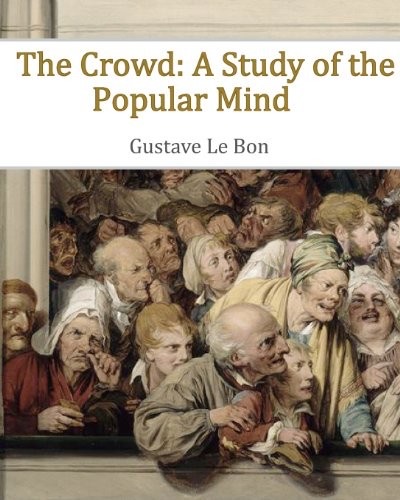
Cover of The Crowd

The Crowd

Gustave Le Bon

6 ideas

  1. The psychological crowd as new entity

    When individuals gather under an exciting cause, their conscious personalities fade and a collective mind forms that is different from the sum of its members. This crowd mind runs on the shared unconscious substrate of race and instinct, not on individual intellect. As a result, its competence tends toward the lowest common level of its members rather than their average.

  2. Anonymity plus numbers dissolves personal responsibility

    Membership in a crowd gives the individual a sense of invincible power from sheer numbers. Anonymity removes the restraint of personal accountability. Together these release instinctive impulses the person would suppress when alone, which is why ordinary people commit acts in crowds they would never commit individually.

  3. Affirmation, repetition, contagion as persuasion engine

    Leaders move crowds in three steps. First comes affirmation, a bare assertion free of proof or reasoning. Next comes repetition, which lodges that assertion in the unconscious until it feels like established truth, and then contagion spreads it laterally through the group like a disease, so that belief propagates by imitation rather than by argument.

  4. Crowds think in images, not arguments

    Crowds cannot follow chains of reasoning; they respond to vivid images and associations evoked by words. A dramatic single incident moves a crowd far more than statistics about thousands of cases. Anyone seeking to sway masses must therefore strike the imagination with concrete, emotionally charged pictures rather than logical demonstration.

  5. Prestige as the paralyzing source of authority

    Prestige is a form of domination that paralyzes the critical faculty of those who perceive it and fills them with astonishment and respect. It can be acquired through office, wealth, or reputation, or be personal and magnetic. Prestige collapses the moment it is questioned or visibly fails, so it survives only while it escapes examination.

  6. Suggestibility makes crowds credulous and extreme

    A crowd exists in a state like hypnosis, where a suggestion taken up by a few is transmitted by contagion to all and immediately turned into action. Because it cannot hold doubt, a crowd accepts or rejects ideas wholesale and treats them as absolute truths or absolute errors. The same mechanism lets a crowd reach heroic self-sacrifice or savage cruelty with equal speed.

Save and mark ideas in the app