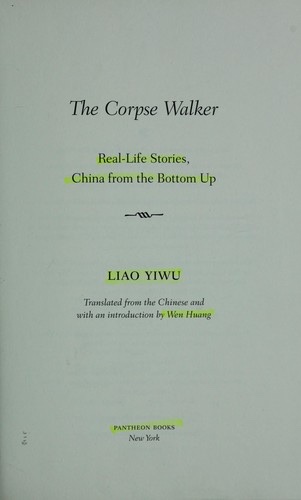
Cover of The Corpse Walker

The Corpse Walker

Liao Yiwu

5 ideas

  1. Corpse walkers carrying the dead home

    In rural Hunan and neighboring regions, corpse walkers were hired to carry the bodies of people who died far from home back to their native villages, because being buried in ancestral soil was considered essential. The Communist state banned the practice as feudal superstition, but economic need and family obligation kept it alive as a clandestine trade. The story shows that a ritual obligation can outlast official prohibition when it is tied to how families understand belonging and a proper death.

  2. Grief as a hired performance

    The professional mourner is paid to wail, sing laments, and perform sorrow at funerals, sometimes adding entertainment to draw crowds. Families pay for it because a funeral's public display of emotion signals the family's status and filial duty. When a family's standing depends on how loudly a death is mourned, the emotion can be separated from the mourner and sold as a service.

  3. History told from the bottom rung

    The book records the Maoist campaigns and the reform era through the memories of landlords' descendants, persecuted believers, petty criminals, and laborers instead of through official accounts. Their testimony exposes violence, famine, and humiliation that the state narrative leaves out or erases. Oral testimony from people the state considers insignificant becomes a counter-archive against official memory.

  4. Market reform created new marginal trades

    The move to a market economy did not lift everyone out of poverty. It pushed displaced people into improvised niches such as running fee-charging public toilets, trafficking people, and robbing graves. These livelihoods show that people at the bottom survive by turning any need or leftover space in society into a source of income, often at the edge of legality.

  5. Interviewing through shared marginality

    Liao was imprisoned for a poem about the Tiananmen massacre and later lived as a street musician. That shared outcast status gave him access to subjects who would never speak to an official or a respectable journalist. His method is to withhold judgment, even with traffickers and criminals, and preserve each speaker's own voice. The interviewer's own exclusion becomes the credential that earns candor.

Save and mark ideas in the app