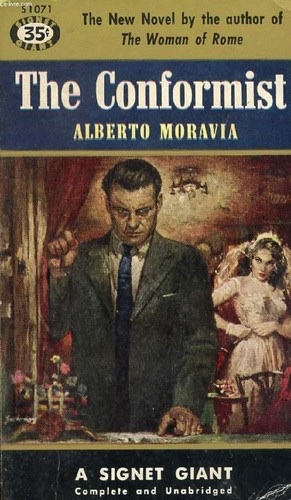
Cover of The Conformist

The Conformist

Alberto Moravia

4 ideas

  1. Marcello Clerici and the Quadri assassination

    As a boy, Marcello shoots Lino, a chauffeur and former priest who tried to seduce him, and believes he has killed him. As an adult he marries Giulia, a simple bourgeois girl, and joins Mussolini's secret service. He uses his Paris honeymoon to set up the assassination of his exiled anti-fascist professor, Quadri, and Quadri's wife Lina, whom Marcello desires, dies alongside him. On the night Mussolini falls in 1943 he meets Lino alive, and soon afterward Marcello and his family are killed by a strafing plane as they flee Rome.

  2. Normality as penance for inner abnormality

    A person who believes something is fundamentally wrong with him does not resist the crowd. He buys membership in it by adopting its most conventional forms: a dull marriage, a state job, the ruling ideology. Conformity works as a cover and an absolution. The more monstrous one feels inside, the more total the outward compliance has to be.

  3. The regime supplies meaning to the rootless

    Marcello serves fascism because it is what everyone around him accepts, not because he believes in it. Its crimes feel justified to him because they are shared and official. Seen this way, totalitarian regimes recruit their most useful functionaries from people who want to belong and be absolved, not from zealots. Ordinary loyalty to consensus is enough to make someone an instrument of murder.

  4. Life built on a false foundation

    Marcello organized his whole adult life to answer one imagined crime. When he learns Lino survived, the justification for every later choice falls away, and the real crime, Quadri's murder, turns out to have been done for nothing. The novel argues that self-remaking driven by guilt can produce greater wrongs than the original act it was meant to redeem.

Save and mark ideas in the app