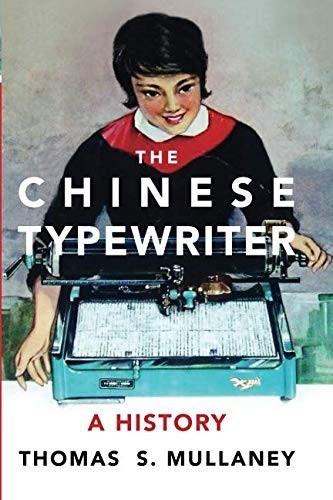
Cover of The Chinese Typewriter

The Chinese Typewriter

Thomas Mullaney

6 ideas

  1. Alphabetic technology made Chinese look deficient

    Nineteenth- and twentieth-century information technologies such as the typewriter and telegraph were designed around the Latin alphabet's small, fixed set of letters. Any script that did not fit this template was then labeled primitive or incompatible with modernity. The incompatibility was built into the machines, not into Chinese writing, but it was blamed on the script and fueled calls to abolish or romanize characters.

  2. Chinese telegraph code and double translation

    Because Morse code encoded alphabetic letters, Chinese telegraphy from 1871 onward used codebooks that assigned each character a four-digit number. Operators converted characters to numbers, transmitted the digits, and converted them back.

  3. Common usage versus combinatorial character strategies

    Engineers who tried to mechanize Chinese settled on two main strategies. The first limited the machine to a few thousand frequently used characters and treated rare ones as exceptions. The second broke characters into recurring components that could be assembled on demand. Each traded completeness against speed and legibility, and neither could simply mimic the alphabetic keyboard.

  4. Lin Yutang's MingKwai typewriter demonstration

    In 1947 the writer Lin Yutang built the MingKwai typewriter. Its keys specified the shapes of character components, and a 'magic eye' window displayed matching candidate characters for the typist to choose from. The machine failed during a demonstration to Remington executives and left Lin deeply in debt. Its select-from-candidates design nonetheless anticipated how Chinese computer input methods would later work.

  5. Typist-rearranged trays as predictive text

    In Mao-era China, typists working on large character-tray machines rearranged the characters so that words and characters frequently used together sat next to each other. This cut hand travel and search time. Grouping characters by how often they appear together was an early, manual form of predictive text, invented by users rather than engineers.

  6. Typing as retrieval, not spelling

    Alphabetic typing spells a word by pressing one key for each letter, so what you press is what appears. Chinese typing instead uses keystrokes as search criteria to find and select the intended character from a larger set. Seeing typing as querying rather than spelling shows that Chinese input anticipated autocomplete and predictive interfaces, which alphabetic users adopted only later.

Save and mark ideas in the app