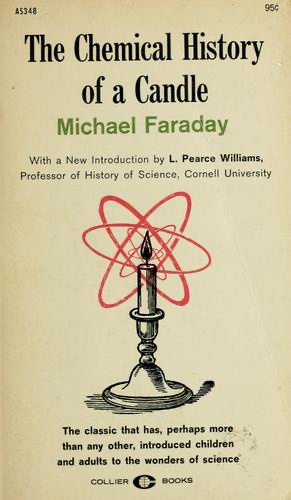
Cover of The Chemical History of a Candle

The Chemical History of a Candle

Michael Faraday

6 ideas

  1. The candle cup as self-regulating wick system

    The flame's heat melts the wax near it, while rising air currents cool the edges of the candle, which leaves a raised rim that holds a cup of liquid fuel. Capillary action draws the melted wax up the wick to the flame. The flame manufactures its own fuel container and delivery system, so the design keeps itself running.

  2. Flames burn vapor, not solid or liquid

    Wax does not burn as a solid or a liquid. It must first be vaporized, and the combustion happens in the gas. Faraday shows this by drawing unburnt vapor off the dark center of a flame through a tube and lighting it at the far end, and by relighting a blown-out candle through its rising smoke.

  3. Flame brightness comes from glowing solid particles

    A candle flame is luminous because solid carbon particles are released inside it and heated to incandescence before they burn away. Burning hydrogen or alcohol, which produces no solid particles, gives a hot but nearly invisible flame. Brightness therefore depends on solids being present, not on how much heat is produced.

  4. Combustion products are conserved, not destroyed

    Burning does not make matter disappear. The candle is converted into water and carbon dioxide, and both can be collected, weighed and identified. Faraday condenses water from a flame and turns limewater milky with the gas it gives off, which shows that the vanished wax has moved into the air as new substances.

  5. Respiration as slow internal candle burning

    Breathing is the same chemical process as a burning candle. The body combines carbon from food with oxygen from the air and releases carbon dioxide and heat, just more slowly and without a flame. Seeing respiration this way ties animal life, plants that take up carbon dioxide, and the atmosphere into one cycle of carbon exchange.

  6. Teaching science through one familiar object

    Faraday takes a single everyday object and pulls a whole science out of it with live demonstrations. Each lecture follows one observable question, such as why the flame is shaped as it is or where the wax goes. He answers it with an experiment the audience watches, and every answer raises the next question. Because the principles are built from things people have seen for themselves, the knowledge rests on evidence rather than on authority.

Save and mark ideas in the app