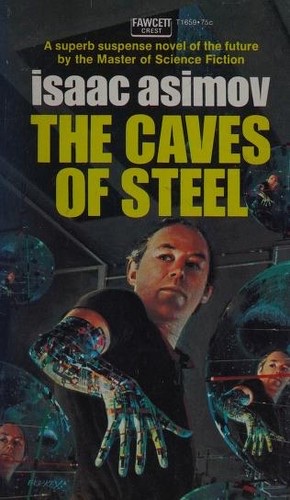
Cover of The Caves of Steel

The Caves of Steel

Isaac Asimov

4 ideas

  1. The Spacetown murder of Dr. Sarton

    Spacer roboticist Roj Nemennuh Sarton is found blasted to death in Spacetown, and Baley twice publicly accuses his robot partner R. Daneel Olivaw, first of being a disguised human and then of being the killer. Both accusations are wrong. The killer is Baley's own boss, Police Commissioner Julius Enderby, a secret anti-robot Medievalist who meant to destroy Daneel, who was built in Sarton's likeness. Enderby had the unwitting robot R. Sammy carry the blaster across open country, then had Sammy destroyed to hide the trail.

  2. Hard rules exploited through partitioned knowledge

    The Three Laws bind a robot only to harms it can foresee. A robot can be made an instrument of murder by giving it one harmless-looking task, such as carrying an object, while withholding what that task is for. The puzzle turns on seeing that an absolute behavioral constraint stays absolute but becomes porous once intent is split between an informed human and an ignorant agent.

  3. Enclosure breeds a civilization-wide fear of openness

    Earth's billions live in sealed, domed Cities, and they have developed a collective agoraphobia that makes open sky and emigration psychologically unbearable. The Spacers argue that Earth will stagnate and die unless its people break out and colonize new worlds. They see a mixed human-robot culture, which they call C/Fe, as the lever for pushing them out. The same comfort and safety that let a society survive crowding can trap it in place.

  4. Automation anxiety drives nostalgic backlash movements

    City workers who are 'declassified' when robots take their jobs lose status and rations. Their loss feeds the Medievalists, who romanticize a pre-City, pre-robot past and stage riots against robots in shops. The lens reads anti-technology sentiment as a reaction to status loss and economic displacement, not as a reasoned argument about machines.

Save and mark ideas in the app