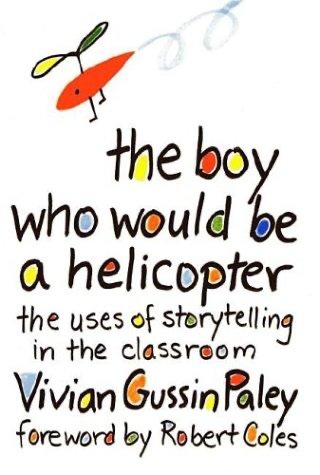
Cover of The Boy Who Would Be a Helicopter

The Boy Who Would Be a Helicopter

Vivian Gussin Paley

4 ideas

  1. Jason's helicopter enters the classroom

    Paley did not correct the fantasy. She kept taking down his helicopter stories and staging them on the class's story-acting line, and over the year classmates began writing helicopters into their own stories and Jason began letting other children and characters into his. The fixation stayed the same while its function changed, from a wall around him to a way into the group.

  2. Story dictation plus dramatization on stage

    The teacher writes down, word for word, any story a child tells, and later that day the class acts it out on a taped-line stage, with the author casting peers in the roles. Dramatization makes a private narrative public and shared, so other children must engage with the author's ideas and the author must accept their bodies and interpretations in his story. This creates a daily, structured social contract that is harder to reach through free play alone.

  3. Fantasy play is children's primary social language

    Young children negotiate belonging, fear and identity through pretend play more fluently than through direct talk or adult-led instruction. An idiosyncratic fantasy is therefore not a symptom to extinguish but the child's current vocabulary. Inclusion happens when the group learns to read that vocabulary and the child learns to borrow theirs.

  4. Teacher as observer of the child's logic

    Rather than diagnosing a difficult child against a norm, the teacher studies what the child's repeated behavior accomplishes for him, such as the safety, control or meaning the helicopter provides, and then builds bridges from inside that logic. The teacher's own uncertainty and changing interpretations become data, recorded and revisited like the children's stories.

Save and mark ideas in the app