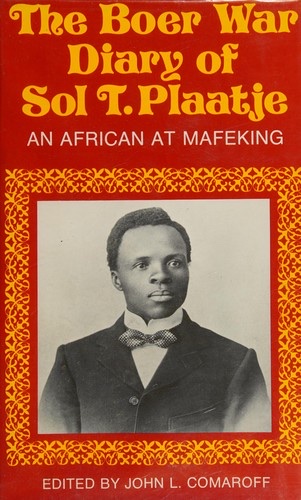
Cover of The Boer War Diary

The Boer War Diary

Sol Plaatje

4 ideas

  1. A Black interpreter's siege diary, rediscovered

    During the 217-day Boer siege of Mafeking (October 1899 – May 1900), Sol Plaatje was in his twenties and worked as a court interpreter for the town magistrate. He kept a private English-language diary recording the daily shelling, court cases, rationing, and the part the Barolong people of the nearby Stadt played in the defence. The manuscript lay unknown for roughly seventy years and was published in the 1970s. It is the only known African eyewitness diary of a siege whose public history had been built around Baden-Powell and the white garrison.

  2. Siege scarcity is allocated along racial lines

    Under blockade, the authorities decided who got food, and Africans received smaller rations and worse food. The town ran soup kitchens serving thin horse-meat broth to Africans, and many Africans were pushed to leave and try to cross Boer lines, where some were shot. The famous 'heroic endurance' of the besieged town depended on the hunger and expulsion of its Black inhabitants. The celebrated relief then credited white defenders almost entirely.

  3. Irony as a way of recording terror

    Plaatje writes about incoming shells, the big Boer gun, and the Sunday ceasefires with dry humour and mock-epic phrasing instead of dread. Treating bombardment as something with its own habits and schedule made it predictable, and this turned terror into material the writer could observe and live with. The comic register lets a person under threat stay the narrator of events, not only their victim.

  4. The interpreter's double vantage point

    A court interpreter who works across several African languages, Dutch, and English is essential to colonial administration but has no power within it. Every dispute and command passes through him, so he sees how the system actually treats people. He also sees what each side does not understand about the other. This intermediary position gives a marginal person more complete knowledge than either the rulers or the ruled have, which is what makes his record uniquely revealing.

Save and mark ideas in the app