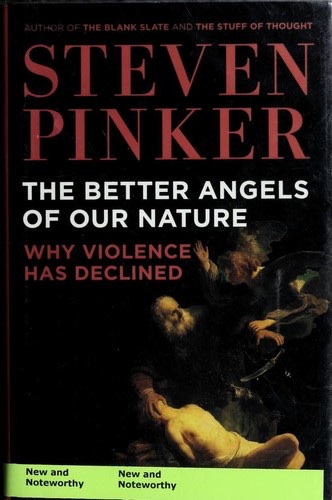
Cover of The Better Angels of Our Nature

The Better Angels of Our Nature

Steven Pinker

6 ideas

  1. The Leviathan and the Pacification Process

    The shift from anarchic tribal societies to the first agrarian states brought roughly a fivefold drop in violent death rates. A central authority with a monopoly on force removes the need for preemptive attack and revenge cycles, because a third party now punishes aggression and makes it unprofitable. Individuals no longer have to keep a reputation for hair-trigger retaliation to deter predators.

  2. The Civilizing Process Through Self-Control

    Between the late Middle Ages and the twentieth century, European homicide rates fell by 10 to 50 times. This happened as centralizing kingdoms and expanding commerce rewarded people who could restrain impulses and take the perspective of distant trading partners. Norms of etiquette, delayed gratification, and self-restraint were internalized, turning external policing into internal inhibition.

  3. Inner Demons Versus Better Angels

    Human nature contains five motives that push toward violence: predatory instrumental violence, dominance, revenge, sadism, and ideology. It also contains four faculties that push away from it: empathy, self-control, the moral sense, and reason. Violence declines not because human nature changes but because historical circumstances increasingly favor the angels over the demons.

  4. The Escalator of Reason Expands Moral Circles

    Literacy, education, and cosmopolitan exposure train people to take abstract, impartial perspectives and to treat their own interests as interchangeable with others'. Rising reasoning ability, including the Flynn effect's gains in abstract thinking, lets people recognize violence as a problem to be solved rather than a contest to be won. Moral concern then extends to wider groups.

  5. Rates Not Body Counts Reveal Violence Trends

    Judging historical violence by absolute death tolls makes the twentieth century look uniquely bloody, because world population was vastly larger. Measuring deaths as a proportion of population shows that many premodern wars, massacres, and tribal raids were far deadlier per capita. Vivid recent atrocities feel more representative than they are because memory and media overweight availability and recency.

  6. The Pacifist's Dilemma and Its Solutions

    In a payoff matrix between two potential aggressors, unilateral peacefulness risks exploitation, so both sides rationally stay armed and violence persists. A Leviathan penalizes aggression, gentle commerce makes the other party worth more alive, and feminization and expanding empathy raise the value placed on the other side's well-being.

Save and mark ideas in the app