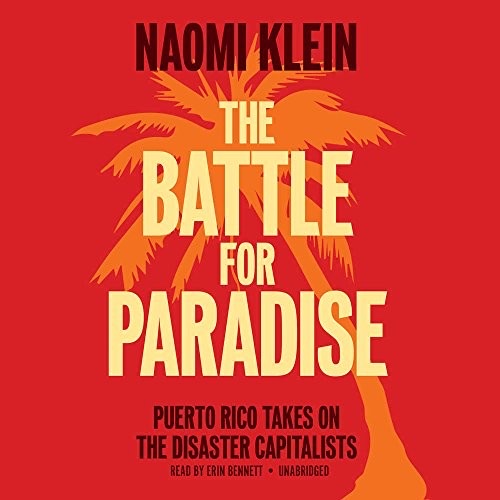
Cover of The Battle for Paradise: Puerto Rico Takes on the Disaster Capitalists

The Battle for Paradise: Puerto Rico Takes on the Disaster Capitalists

6 ideas

Buy on Amazon
  1. Disaster capitalism exploits post-shock disorientation

    After a catastrophe, populations are too disoriented and preoccupied with survival to defend public institutions, creating a window in which privatization and deregulation get pushed through with little resistance. In Puerto Rico after Maria, this took the form of accelerated moves to privatize the electrical grid, close public schools, and open land to outside investors.

  2. Schools as shuttered privatization targets post-Maria

    In the wake of Hurricane Maria, hundreds of Puerto Rican public schools were slated for closure while charter-school and voucher legislation advanced, framed as reform but functioning as disaster-enabled restructuring. Teachers and communities organized to keep some schools open as neighborhood recovery hubs rather than accept closure.

  3. Debt as leverage for austerity

    Preexisting public debt can be used as the justification to impose an unelected fiscal control board whose mandate overrides local democracy to prioritize creditor repayment over public services. In Puerto Rico the board (La Junta) directed cuts to pensions, schools, and the university while the territory's debt was treated as unquestionable.

  4. Decentralized solar beats centralized grid in disaster

    A centralized fossil-fuel grid creates a single point of failure that leaves an entire island dark for months, whereas distributed rooftop and microgrid solar lets communities keep power, refrigerate medicine, and run water pumps independently. Puerto Rican organizers argued renewable decentralization is not only cleaner but more resilient against the next storm.

  5. Counter-shock through pre-built alternatives

    Movements can resist disaster capitalism only if they have already developed concrete alternatives (agroecological farms, community-run solar, cooperatives) ready to scale when the crisis window opens. The vision must exist before the shock, because in the aftermath there is no time to invent it from scratch.

  6. Recovery as contest over ownership

    Reconstruction after a disaster is not a neutral technical task but a fight over who will own the rebuilt systems: outside investors and corporations, or local communities and the public. Viewing recovery this way reveals that the same physical rebuild can either entrench extraction or seed local self-determination.

Save ideas and give them a thumbs up or down in the app