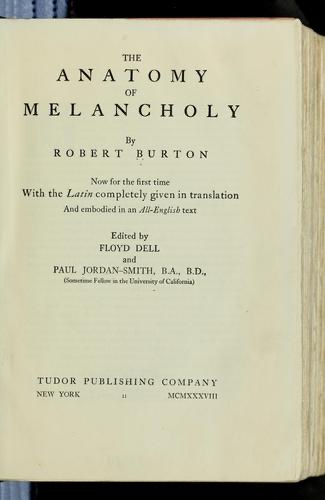
Cover of The Anatomy of Melancholy

The Anatomy of Melancholy

Robert Burton

4 ideas

  1. Burton writing melancholy to escape it

    Robert Burton, an Oxford cleric-scholar who never married and lived his life in Christ Church, wrote the Anatomy under the pseudonym 'Democritus Junior', declaring 'I write of melancholy, by being busy to avoid melancholy.' The book is therefore a documented case of a patient using obsessive scholarly labor as self-treatment, with the ballooning text serving as both the therapy and evidence of the condition.

  2. Idleness is the chief cause of melancholy

    Burton argues that idleness of body and mind is the principal cause of melancholy: an unoccupied mind turns on itself and breeds fears, griefs and imaginary troubles. His prescribed remedy is busyness itself, meaning study, labor and exercise that give the mind an external object.

  3. Melancholy mapped as causes, symptoms, cures

    Burton organizes his subject medically, in partitions subdivided into sections, members and subsections, laid out in branching synoptic tables. The first partition treats causes (supernatural, natural, bodily, passions, diet, education), the second cures, and the third special kinds such as love-melancholy and religious melancholy. Treating an emotional state as a classifiable disease with separable causes lets each strand be addressed with its own remedy, from diet and air to friendship and music.

  4. Melancholy as the universal human condition

    In the satirical preface 'Democritus Junior to the Reader', Burton argues that the whole world is mad and melancholic: kingdoms, professions, scholars and lovers all act from folly and disordered passion. Seen this way, melancholy is the ordinary state of fallen humanity rather than a rare pathology, and the diagnostician is as sick as his patients. The line between physician and patient disappears, and the treatise becomes an anatomy of everyone, its author included.

Save and mark ideas in the app