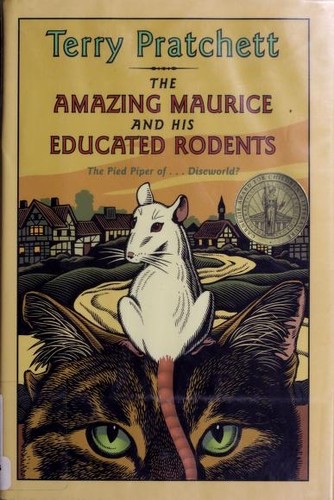
Cover of The Amazing Maurice and His Educated Rodents

The Amazing Maurice and His Educated Rodents

Terry Pratchett

4 ideas

  1. The Pied Piper con in Bad Blintz

    In Bad Blintz the con collapses when they discover the town's real rat plague was faked by two rat-catchers, and that the rat-catchers serve Spider, a monstrous rat king that controls minds and wants war between rats and humans. The episode ends with the rats negotiating a treaty with the town, trading pest control for recognition as citizens rather than vermin.

  2. Literacy creates conscience and moral doubt

    When the rats learn to read and think in words, they gain more than skill. They start asking whether killing, stealing, and eating the dead are right, and they begin to fear death as something that happens to a 'me'. Being able to represent ideas gives them a self that can be held responsible, so their intelligence brings ethical burden and existential anxiety along with it.

  3. Stories as maps that mislead

    The rats navigate by 'Mr. Bunnsy Has An Adventure', a children's picture book they treat as a guide to how the world works, where animals wear clothes and humans are kindly. The story fails them as a literal description but works as an aspiration: it shows a world where rats and humans cooperate, and that vision motivates them to build one. A story can be false as a report and true as a blueprint, and confusing the two leads to danger or to progress.

  4. Negotiated coexistence replaces the zero-sum scam

    The con works by exploiting human fear of rats, and Spider's plan depends on escalating that fear into war. Both are adversarial. Dangerous Beans and Darktan's resolution is to make the rats' value legible to the town through a contract (rats police other rats, humans pay and grant rights), which turns a predator-prey conflict into a repeated, mutually beneficial deal.

Save and mark ideas in the app