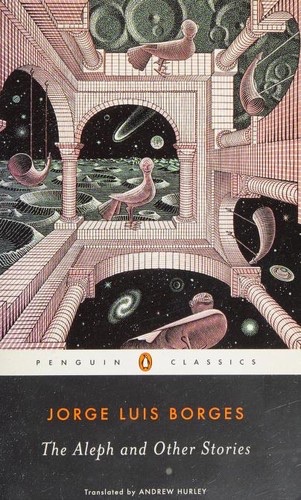
Cover of The Aleph

The Aleph

Jorge Luis Borges

5 ideas

  1. The Aleph in Daneri's Buenos Aires cellar

    Borges, the narrator, mourns Beatriz Viterbo and visits her cousin Carlos Argentino Daneri, a vain poet writing an endless verse catalogue of the whole Earth. Daneri shows him a point under the nineteenth step of the cellar on Garay Street that contains every place in the universe seen at once from every angle, including obscene letters Beatriz wrote to Daneri. The narrator hides his awe, calls the Aleph false, and says language can only list things one after another, so it cannot render what he saw all at once; his memory of the vision soon fades.

  2. Endless time dissolves individual identity

    In 'The Immortal,' a Roman tribune drinks from a river of immortality and finds that, given infinite time, every man eventually does every deed and thinks every thought, so no one is anyone in particular. The Immortals, Homer among them, sink into apathy because no act is unique when every act will recur. Mortality is what makes choices precious and gives a person a distinct self.

  3. The Zahir: an object that consumes attention

    The Zahir is a thing, in the story an ordinary twenty-centavo coin, that cannot be forgotten once seen. Its image grows in the mind until it displaces the rest of the world. The mechanism is a feedback loop: each attempt to stop thinking about it reinforces it, so an ordinary object becomes, by force of repetition, the only real thing.

  4. Retell the monster from inside

    'The House of Asterion' narrates the labyrinth myth in the Minotaur's own voice, and he comes across as a lonely, proud, naive being who thinks the youths sent to him are people he is freeing. Telling a story from the villain's side does not excuse him, but it recasts the violence as isolation. It shows that the hero's arrival can be the release the victim was waiting for. Changing the narrator changes what the same events mean.

  5. No concept without its underlying practice

    In 'Averroes' Search,' the great Arabic commentator cannot translate Aristotle's words 'tragedy' and 'comedy.' His culture has no theatre, so he cannot picture it, even though a group of children acting out a scene is playing below his window. The story then admits that the author, lacking Averroes' world, has equally failed to imagine Averroes. You cannot grasp an idea whose real-world practice is missing from your experience, however intelligent you are.

Save and mark ideas in the app