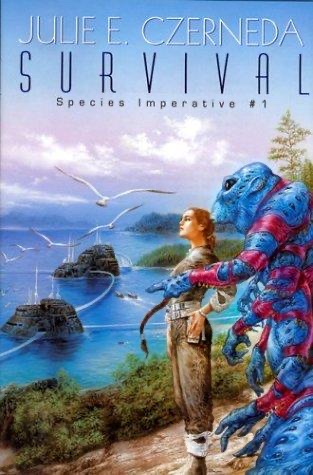
Cover of Survival

Survival

Julie E. Czerneda

4 ideas

  1. Salmon biologist recruited to explain dead worlds

    Dr. Mackenzie 'Mac' Connor runs a salmon research station at Castle Inlet in the Pacific Northwest until Brymn Las, an alien Dhryn archaeologist, arrives seeking her help and violent attacks follow him. The novel's case is that a fisheries biologist's field knowledge, not military or diplomatic expertise, is what cracks an interstellar extinction mystery.

  2. Species imperatives override individual intention and culture

    A species can carry a programmed life-cycle stage that its individual members neither remember nor control. When that stage triggers, biology overrides personal goodwill, culture, and treaties. So a species can be sincerely peaceful as individuals and still be catastrophically destructive as a population. Moral judgment aimed at individuals misreads a threat whose cause sits at the level of the life cycle.

  3. Read spatial destruction patterns as life history

    A trail of events spread across a landscape can be read as the footprint of an organism's life cycle rather than as a sequence of accidents, wars, or disasters. The ecologist's question is not 'what happened here?' but 'what animal leaves this pattern, and at what stage of its life?' Spawning migrations, home-range returns, and die-offs each leave a distinct spatial signature. Matching the signature identifies the mechanism.

  4. Analogical transfer from an outsider discipline

    Experts inside a domain often stay inside that domain's categories, such as politics, archaeology, or security, and miss mechanisms that another field treats as routine. An outsider carries a ready-made model, like anadromous fish returning to natal waters, and can map it onto unfamiliar data to generate testable predictions. The value comes from the structural match between systems, not from any knowledge of the new domain.

Save and mark ideas in the app