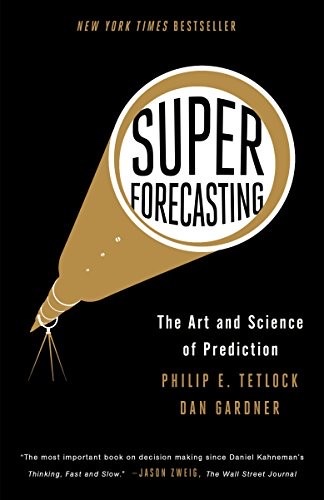
Cover of Superforecasting

Superforecasting

Philip E. Tetlock and Dan Gardner

6 ideas

  1. Amateurs beat analysts in IARPA tournament

    IARPA, the US intelligence community's research agency, ran a multi-year geopolitical forecasting tournament. The Good Judgment Project, staffed by volunteers, beat the control group and rival academic teams by wide margins. Its top performers were reportedly about 30% more accurate than intelligence analysts who had access to classified information, which shows that disciplined method can outperform privileged data.

  2. Keeping score with Brier scores

    Forecasts can only improve if they are specific enough to be scored: a numeric probability, a clear outcome, and a deadline. The Brier score measures the squared gap between stated probabilities and what actually happened. It rewards both calibration (70% calls come true about 70% of the time) and resolution (confident calls that turn out right). Vague terms like 'a serious possibility' escape accountability, so they block learning.

  3. Outside view first, then inside view

    Start from the base rate: how often do events of this kind happen across comparable cases? Then adjust using the particulars of the case at hand.

  4. Fermi-izing unanswerable questions

    Break a seemingly unknowable question into smaller sub-questions that can each be estimated. Separate what is known from what is unknown, make explicit guesses for each part, and combine them. The errors in the separate guesses tend to partly cancel, so the result is far better than a single gut estimate. The method also exposes which assumptions drive the answer.

  5. Accuracy comes from frequent small updates

    Top forecasters revise often and in small increments as new information arrives, which roughly follows Bayesian reasoning. They avoid both underreaction, from clinging to a prior commitment, and overreaction, from chasing every headline. What predicts accuracy is the habit of treating beliefs as hypotheses to test, a mindset of 'perpetual beta', more than raw intelligence.

  6. Foxes versus hedgehogs in prediction

    Hedgehogs organize everything around one big idea and state conclusions with confidence. Foxes draw on many frameworks, tolerate ambiguity, and qualify their judgments. In Tetlock's earlier expert study, foxes forecast measurably better than hedgehogs. Yet hedgehogs' decisive, story-driven style gets them more media attention, so the experts the public hears most from tend to be less accurate.

Save and mark ideas in the app