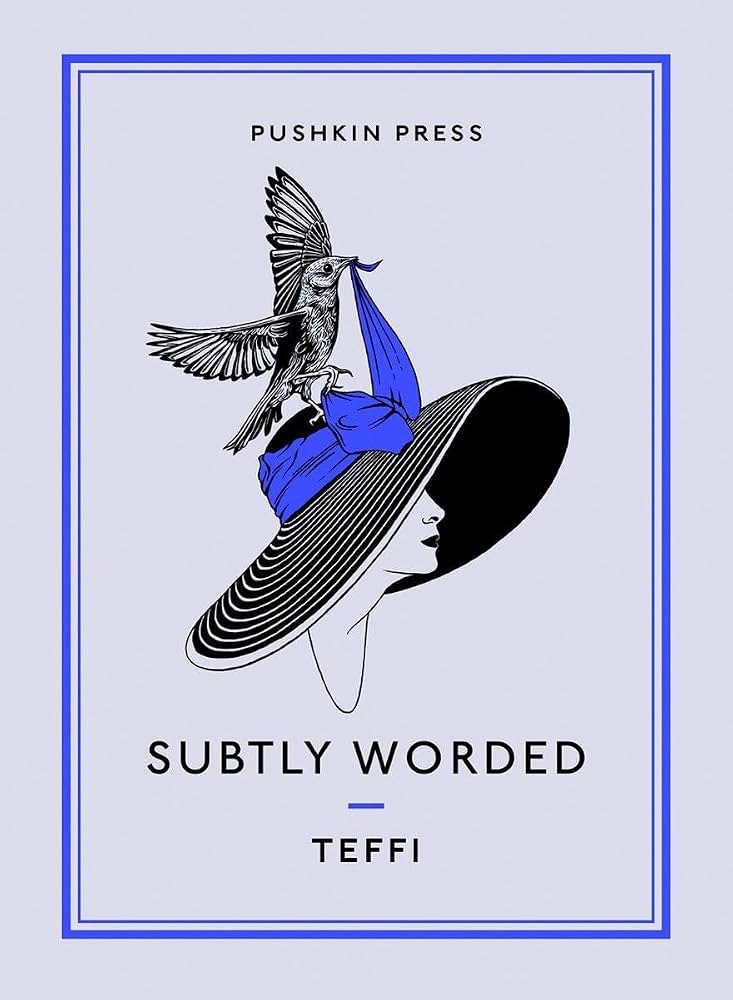
Cover of Subtly Worded

Subtly Worded

Russia · 1900–1930

3 ideas

Buy on Amazon

An English selection of Teffi's short stories and sketches, from comic pre-revolutionary Petersburg to revolution, flight and émigré life in Paris, treating catastrophe through small human absurdities.

  1. The émigré general's question: que faire?

    A Russian general, newly arrived in Paris, stands in the Place de la Concorde, looks around at the thriving city, and asks in broken French, 'Que faire?' ('What is to be done?'). The phrase became a catchphrase of the whole emigration. It shows displacement as a loss of agency, not of comfort: the exile is surrounded by functioning order but has no role within it.

  2. Censorship turns every sentence into code

    When letters might be read by hostile authorities, writers stop saying what they mean and phrase everything obliquely. The burden of meaning then shifts to the reader, who may decode too much, too little, or the wrong thing. Under surveillance, communication does not simply shrink. It becomes a guessing game in which misunderstanding is structural, not accidental.

  3. Comic detail registers catastrophe more truly

    Teffi records revolution and flight through small absurdities: petty vanities, misplaced priorities, people clinging to trivial routines. Her method implies that people meet historical upheaval with their ordinary pettiness and habits intact, so the comic incongruity between event and response is where the real horror and pathos show through.

Save ideas and give them a thumbs up or down in the app