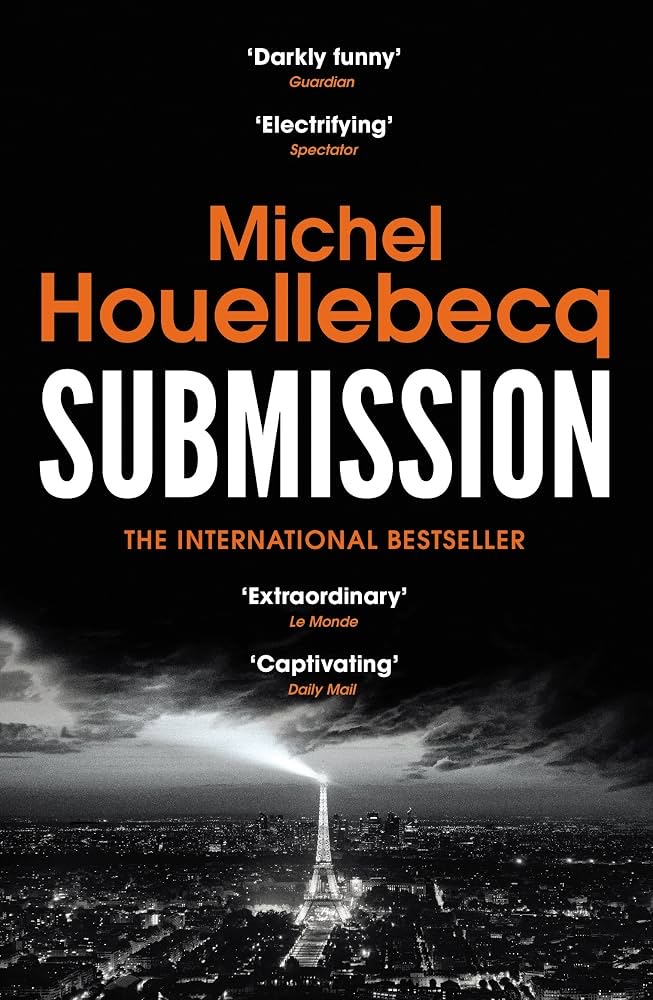
Cover of Submission

Submission

France · 2022

4 ideas

Buy on Amazon

France’s fictional 2022 election brings a Muslim party to power. François, a disaffected professor devoted to Huysmans, watches the country change while struggling to find much he believes in himself. Houellebecq’s satire follows that political upheaval through a man whose private emptiness gives it a sharper edge.

  1. Huysmans scholar converts for comfort, not faith

    François, a middle-aged Sorbonne specialist in the decadent novelist Huysmans, watches the Muslim Brotherhood candidate Mohammed Ben Abbes win the 2022 runoff against Marine Le Pen with the backing of the Socialists and the center-right. The university becomes a Saudi-funded Islamic Sorbonne, and non-Muslim faculty are retired on generous pensions.

  2. The threat is internal emptiness, not invasion

    The novel's political scenario works as a diagnostic, not a prophecy. France submits because the narrator and his class believe in nothing, so anything that offers structure, status, and sexual order meets no resistance. The discomfort comes from recognizing that the conversion is a rational choice for someone with no inner life to defend.

  3. Submission as relief from exhausted freedom

    Read liberal individualism's endpoint as exhaustion. When a person has already used up pleasure, career, and romance and found each hollow, total submission to an external authority feels like rest rather than defeat. On this view, the appeal of an authoritarian order lies in removing the burden of self-authorship, not in its doctrine.

  4. Elite accommodation through material incentive

    Institutions change hands without confrontation when the new power pays the old guard to comply. Academics, politicians, and professionals adjust their convictions to preserve salaries, prestige, and comfort, and they reframe opportunism as pragmatism or openness. The regime change is completed by careerism rather than coercion.

Save ideas and give them a thumbs up or down in the app