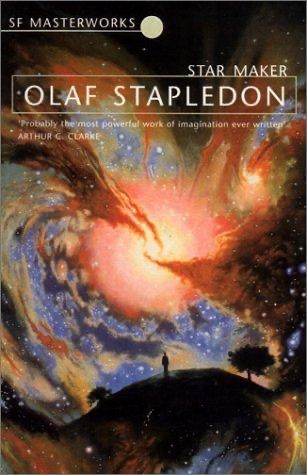
Cover of Star Maker

Star Maker

Olaf Stapledon

4 ideas

  1. The Other Earthlings' radio-driven collapse

    The narrator's first alien hosts, the Other Men, taste through their hands and feet. Their civilisation turns commercial broadcasting of synthetic taste and sensation into a tool of mass pacification, then into crude religious nationalism, and it destroys itself. Stapledon uses them as a near-mirror of 1930s Europe: the same crisis of spirit occurring on a world that looks almost like ours.

  2. Telepathic communion as a scalable mind

    Across the book, individual minds link telepathically into group minds, then world-minds, then galactic and cosmic minds. Each larger mind keeps its members as distinct persons and gains an awareness none of them could hold alone. A mind at a higher level of integration perceives things invisible from below, rather than simply adding up what lower minds can see.

  3. The creator values excellence over creatures' welfare

    When the narrator finally meets the Star Maker, he finds a creator who makes cosmoses as an artist makes works. The Star Maker judges each cosmos by its perfection of form, not by the happiness of the beings who suffer inside it.

  4. Cosmic scale as a test of moral conduct

    The narrator's journey reduces human history to a flicker among billions of years and countless worlds. Stapledon still insists that ordinary human loyalty, symbolised by the narrator's return to his wife and their hilltop at night, keeps its worth. Viewing a present crisis against deep time strips away tribal urgency while leaving intact the obligation to act decently where one stands.

Save and mark ideas in the app