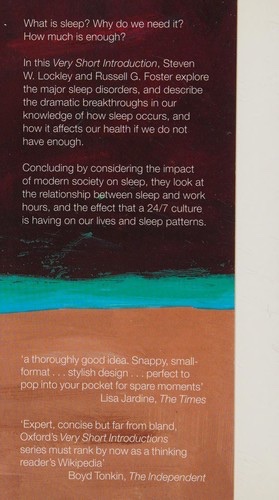
Cover of Sleep: A Very Short Introduction

Sleep: A Very Short Introduction

6 ideas

Buy on Amazon
  1. The two-process model of sleep regulation

    Sleep timing is governed by two interacting systems: a homeostatic sleep pressure that builds up the longer you stay awake, and a circadian process that promotes wakefulness at certain times of day independent of how tired you are. The circadian alerting signal rises through the evening to counteract mounting sleep pressure, which is why you can feel a 'second wind' late at night despite having been awake all day.

  2. The suprachiasmatic nucleus as master clock

    A small cluster of cells in the hypothalamus, the suprachiasmatic nucleus, acts as the body's master circadian pacemaker, generating a rhythm close to but not exactly 24 hours. It is reset daily to the external day by light signals, keeping internal time aligned with the solar cycle.

  3. Light as the dominant circadian time-giver

    Light is the primary signal that entrains the internal clock, detected not by the rod and cone cells used for vision but by a separate class of retinal cells most sensitive to blue light. Because of this, evening exposure to artificial and screen light can delay the clock and push sleep later.

  4. Sleep architecture cycles through distinct stages

    Sleep is not uniform but moves through repeating cycles of roughly 90 minutes, alternating between non-REM stages (including deep slow-wave sleep) and REM sleep where most vivid dreaming occurs. Deep slow-wave sleep dominates early in the night while REM periods lengthen toward morning.

  5. Chronic short sleep carries health costs

    The authors argue that persistently curtailed sleep is associated with raised risks of metabolic problems, cardiovascular disease, impaired immune function and cognitive deficits, through pathways such as disrupted glucose regulation and hormonal balance. They present these as correlations and plausible mechanisms rather than claiming sleep loss is the sole cause of any one disease.

  6. Chronotype as biologically set timing variation

    People differ systematically in their preferred sleep timing (morning 'larks' versus evening 'owls') largely because of genetically influenced differences in their internal clocks, not merely habit or discipline. Social schedules built around early starts therefore impose a biological disadvantage on late chronotypes, producing a mismatch the authors call social jetlag.

Save ideas and give them a thumbs up or down in the app