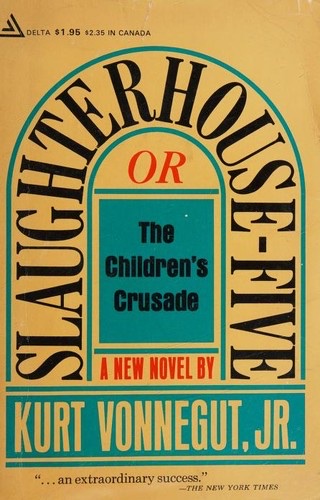
Cover of Slaughterhouse-Five

Slaughterhouse-Five

Kurt Vonnegut

4 ideas

  1. Billy Pilgrim survives Dresden in meat locker

    Billy Pilgrim, an unarmed chaplain's assistant captured at the Battle of the Bulge, is held with other American POWs in Slaughterhouse-Five in Dresden, and on 13 February 1945 they survive the Allied firebombing sheltered in an underground meat locker. They emerge to a city reduced to something like the surface of the moon, and are then set to dig corpses out of cellars; later the soldier Edgar Derby is shot for taking a teapot from the ruins. The episode mirrors Vonnegut's own experience and is the fixed point the whole non-linear narrative keeps returning to.

  2. Time travel as trauma, rule kept

    Billy's becoming 'unstuck in time' can be read as dissociation from war trauma: the scenes he is pulled into keep circling Dresden, and his account of the Tralfamadorians comes after a head injury in a plane crash and after reading Kilgore Trout's science fiction. The novel still keeps its stated rule and never breaks it: every moment always exists, and Billy only moves between moments without changing any of them. The book therefore works both as a case study of a mind and as a consistent four-dimensional universe, and neither reading cancels the other.

  3. Tralfamadorian block time and fatalist consolation

    Tralfamadorians see all moments at once, the way humans see a range of mountains, so a dead person is simply dead in that moment and alive in many others. This view removes free will and makes the right response to death a shrug: 'So it goes,' repeated after every death in the book. The consolation it offers is to dwell on good moments and ignore bad ones, which the novel presents as both soothing and morally troubling, since it also removes any reason to prevent atrocity.

  4. War stories must refuse glory to be honest

    Vonnegut argues that conventional war narratives turn babies into heroic men and so make the next war more attractive, which is why the subtitle is 'The Children's Crusade.' The honest alternative shows soldiers as bewildered, passive, and young, and gives massacre no narrative logic, because 'there is nothing intelligent to say about a massacre.' The book's broken, anticlimactic structure is itself the argument, and it ends not in triumph but with a bird saying 'Poo-tee-weet?'

Save and mark ideas in the app