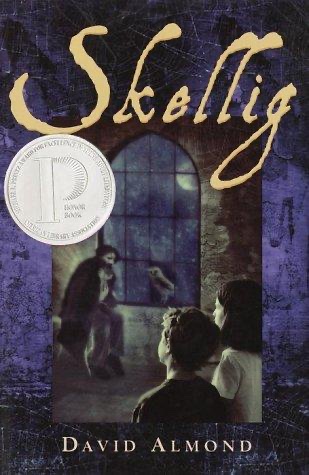
Cover of Skellig

Skellig

David Almond

4 ideas

  1. Michael nurses Skellig while sister struggles

    Michael, whose family has just moved into a run-down house, finds a filthy, arthritic man-like creature, eating dead bluebottles, in the collapsing garage while his premature baby sister lies in hospital with a heart condition. With his home-schooled neighbour Mina he feeds him Chinese takeaway and brown ale, moves him to an abandoned house, and discovers wings beneath his coat.

  2. Shoulder blades as vestigial wings

    Mina tells Michael that shoulder blades are where wings used to be, and where they will grow again, rewriting the human body as a record of a lost or future capacity rather than a finished form. The idea works as a hinge for the book's attention to incompleteness: evolution, a sick infant, and a crippled winged being are all bodies midway between one state and another.

  3. Unexplained wonder is held, not solved

    The narrative deliberately refuses to classify Skellig as angel, owl-like creature, or derelict tramp, and the children never tell adults what they found. This argues that some experiences stay real only while unnamed: explaining them would reduce them to one category and dissolve what they do for the person who lived them.

  4. Reciprocal healing through tending another

    Michael cannot help his sister, so he redirects his helplessness into caring for a being he can actually feed and move, and the care restores both of them: Skellig regains strength while Michael regains agency and hope. Read this way, nursing someone else is not a distraction from one's own crisis but a channel through which fear becomes action, and help flows in both directions.

Save and mark ideas in the app