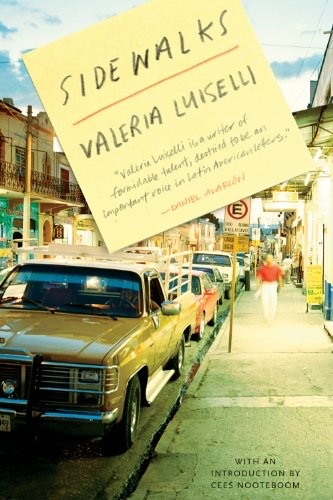
Cover of Sidewalks

Sidewalks

Valeria Luiselli

5 ideas

  1. Searching for Brodsky's grave in Venice

    Luiselli crosses to San Michele, Venice's cemetery island, to find the grave of Joseph Brodsky, a Russian exile buried in a city that was neither his birthplace nor his adopted home. The search, made among the island's paths and graves, turns into a meditation on how a writer's final place is chosen and how visitors turn a grave into a site of reading. It is a concrete case of a pilgrimage to a place where the destination matters less than the wandering and the attention it produces.

  2. Relingo: the productive urban void

    A relingo is Mexican slang for an empty lot, a leftover gap or dead space in the urban fabric. Luiselli treats these gaps as where a city breathes, where no function is assigned and the passerby's thought has room to move. She extends the idea to writing: a text needs its own relingos, blank or unresolved spaces that invite the reader in rather than filling every surface.

  3. The bicycle as a speed of perception

    Cycling moves faster than walking and slower than a car, so the cyclist sees the city in linked fragments rather than as isolated details or a blur. The cyclist is also an ambiguous figure, neither pedestrian nor motorist and belonging fully to neither space. That in-between position turns urban movement into a kind of reading, and it makes riding a bike in a car-dominated city a quietly political act.

  4. Perec-style inventory of a new place

    To take possession of an unfamiliar city, you systematically note what is ordinarily overlooked: street names, surfaces, objects, the routine and the banal, recorded from a fixed or repeated vantage. The discipline of listing the "infra-ordinary" replaces the tourist's search for landmarks with sustained attention. Over time this produces a personal map that is made of observation rather than of monuments.

  5. Writing moves like walking, by digression

    Luiselli argues that the essay follows the logic of a walk: it proceeds by detours, stops, and chance encounters rather than a straight line to a conclusion. Memory and thought are organized spatially, so moving through streets and moving through ideas are the same kind of act. A city's layout therefore shapes what its writers can think, and a text can be read as a route through a territory.

Save and mark ideas in the app