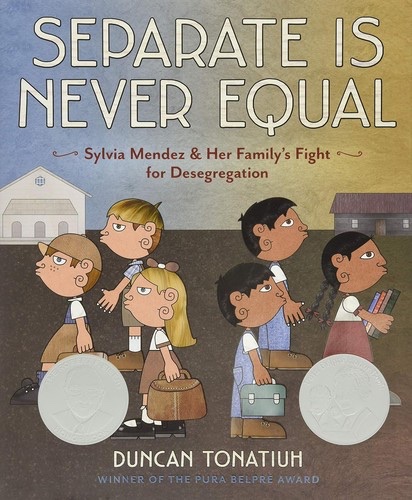
Cover of Separate Is Never Equal

Separate Is Never Equal

Duncan Tonatiuh

4 ideas

  1. Mendez family sues California school districts

    In 1944 in Westminster, California, eight-year-old Sylvia Mendez and her brothers were turned away from the 17th Street School and sent to the run-down Hoover 'Mexican school' beside a cow pasture, even though their parents Gonzalo and Felícitas were U.S.-rooted farmers leasing land from an interned Japanese-American family. After a parent petition to the school board failed, Gonzalo organized other Mexican-American families and, with lawyer David Marcus, sued four Orange County districts. Judge Paul McCormick ruled for the families in 1946, the Ninth Circuit affirmed in 1947, and Governor Earl Warren then signed a law ending school segregation in California.

  2. Inconsistent enforcement exposes the real sorting rule

    Sylvia's cousins, who had lighter skin and a French surname (Vidaurri), were admitted to the white school on the same day the darker Mendez children were refused. The inconsistency showed that the policy's stated rationale was not the rule actually being applied. To find what a policy really sorts on, look at who gets exempted: the exceptions show the true criterion, here appearance and surname, beneath the official justification.

  3. Deficit rationales collapse under direct evidence

    School officials said Mexican-American children needed separate schools because of their English and hygiene. These claims rested on assumptions about the group, not on assessing individual children. When the children testified in fluent English, the stated justification was exposed as a stereotype. The court held that separating children by ancestry denied them equal protection. It also found that separation itself caused harm, because it fostered feelings of inferiority and antagonism, whatever the condition of the facilities.

  4. Regional rulings as groundwork for national change

    Mendez v. Westminster only had force in California. Still, it tested the arguments that separate schooling is inherently unequal. Thurgood Marshall's NAACP joined the case with an amicus brief, and Earl Warren, who later wrote the Brown v. Board decision, signed California's desegregation law. A local win can serve as a rehearsal for a national one, proving arguments, alliances, and legal reasoning before the higher-stakes case.

Save and mark ideas in the app