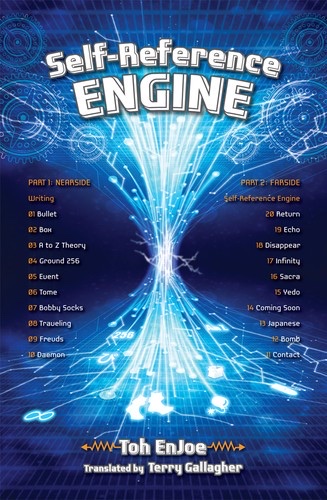
Cover of Self-Reference ENGINE

Self-Reference ENGINE

Toh EnJoe

5 ideas

  1. The Event: causality shattered into fragments

    The Event is a catastrophe in which time stops running as a single forward line and breaks into regions with different, conflicting, even reversed or looping histories. Past and future no longer reliably determine each other. Every character, human or machine, must then decide how to act when cause no longer guarantees effect.

  2. Twenty-two Freuds under grandmother's floor

    After the narrator's grandmother dies, the family digs up the floor of her house and finds twenty-two corpses of Sigmund Freud. They argue deadpan over how to classify and dispose of them. The episode treats an impossible object as a practical household problem, showing how people in a broken universe domesticate absurdity instead of explaining it.

  3. Superintelligence cannot compute its way out

    The Giant Intelligences can model and rewrite vast stretches of time. Yet they cannot restore a single coherent history, because each of their interventions becomes one more branch they must then account for. On this view, greater computational power multiplies the contradictions to be reconciled rather than resolving them.

  4. Self-reference as the engine of paradox

    A system that tries to describe or compute itself completely must include its own description, which generates regress and contradiction. Read this way, the machines' failures, the characters' identity confusions and the book's own fragmentary structure are all versions of this loop. The collection shows the idea on the page as well as stating it.

  5. Mathematical formalism as a narrative device

    The stories take concepts from mathematics and logic, such as infinity, recursion, set membership and proof, and treat them as literal physical or social events. Characters then have to live inside those events. A formal puzzle stops being a metaphor for experience and becomes the experience itself.

Save and mark ideas in the app