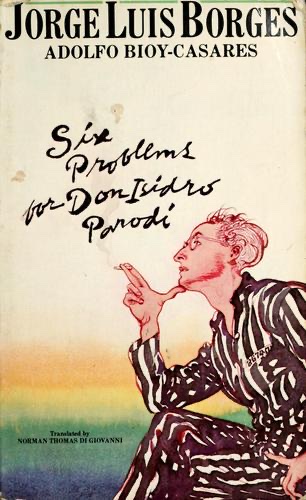
Cover of Seis problemas para don Isidro Parodi

Seis problemas para don Isidro Parodi

H. Bustos Domecq (Borges and Adolfo Bioy Casares)

4 ideas

  1. Parodi solves crimes from Cell 273

    Isidro Parodi, a Buenos Aires barber framed for a murder and serving a long sentence in cell 273 of the National Penitentiary, is visited by vain, garrulous figures such as the journalist Achille Molinari and the actor Gervasio Montenegro. Parodi, who never leaves his cell, shows that Molinari's experience of the ritual was staged and names the real mechanism of the crime from Molinari's account alone.

  2. Deduction needs only testimony, not access

    The book pushes the armchair-detective premise to its limit: a detective with no mobility, no forensic tools and no scene inspection still solves every case. The solution is already present in the witness's words, so detection is the rearranging of reported facts into their only consistent order. Physical investigation is shown to be unnecessary to reasoning, not essential to it.

  3. Read past the narrator's vanity

    Each visitor buries the relevant facts under self-regard, digressions, pretentious vocabulary and social climbing, and misjudges which details matter. Parodi treats the teller's biases as noise to filter and the incidental asides as signal. The facts a speaker considers beneath notice are often the decisive ones, because the speaker has not bothered to shape them.

  4. Parody that keeps the machinery working

    The stories mock the conventions of the classic detective story through absurd characters, ornate satirical prose and a jailed hero, yet each still plays fair: the clues are given and the puzzle has a valid solution. The comedy also works as camouflage, because the reader dismisses the clowning as ornament and misses the clues embedded in it. A form can be satirized and fully performed at the same time.

Save and mark ideas in the app