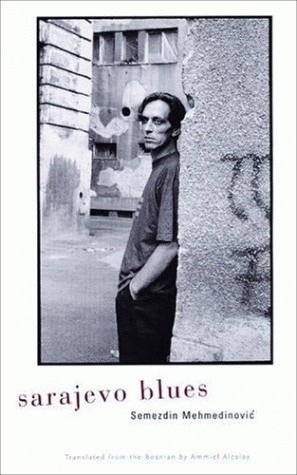
Cover of Sarajevo Blues

Sarajevo Blues

Semezdin Mehmedinović

5 ideas

  1. Writing Sarajevo's siege from inside it

    Mehmedinović stayed in Sarajevo after the Bosnian Serb siege began in April 1992 and wrote these short prose pieces and poems while under daily shelling and sniper fire, not afterward from safety. His subjects are the ordinary mechanics of survival: running across open intersections watched by snipers, queuing for water and bread, sheltering during bombardment, and learning of the deaths of neighbors and friends. First published in 1992 during the war itself, the collection is a first-person record of a European capital under a nearly four-year blockade, not a retrospective history.

  2. Fragments are the honest form under bombardment

    Under siege, time breaks into disconnected moments between shellings, and no one can know how the story ends. A sustained narrative with a controlled arc would falsify that experience. Short, broken pieces that record an image, a death or a thought, then stop, preserve the discontinuity that is the lived truth of the siege.

  3. The besieged as spectacle for outsiders

    Foreign journalists and photographers come to Sarajevo looking for the telling image, which turns residents' suffering into material for audiences who can switch it off. Seen from inside, the camera is complicit: it takes the pain, frames it, and carries it away, while the conditions that caused it continue. The world's attention becomes another way of being looked at while nothing changes.

  4. Normalization of death in daily routine

    When death is constant, it stops being an event and becomes part of the background, as ordinary as the weather or the water queue. The horror lies partly in this adaptation: survivors grow numb so they can keep functioning, and that numbness damages their humanity quietly, alongside the physical destruction.

  5. The sniper reduces a person to a target

    In the besieged city, a sniper sees a person only as a moving body in open ground. Name, ethnicity, profession and history do not matter. This impersonal exposure strips civilians of individuality in the moment of danger. Writing that insists on particular faces and small details works as resistance, because it gives back the individuality the rifle sight erases.

Save and mark ideas in the app