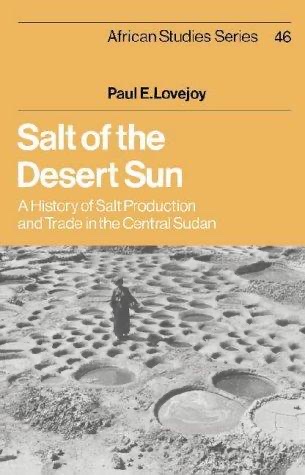
Cover of Salt of the Desert Sun

Salt of the Desert Sun

Paul Lovejoy

4 ideas

  1. Tuareg Salt Caravans from Bilma to Hausaland

    There they traded grain and other goods for moulded salt cones and loose salt made by oasis producers. They carried the salt south to Hausa markets and exchanged it for millet, cloth and other savanna goods, linking desert extraction to savanna consumption in one seasonal circuit.

  2. Precolonial Salt Production Was an Industry

    Salt making in the Central Sudan was not a marginal craft. It was an industry with specialized production sites, large seasonal workforces and substantial output tonnage. Production was organized for distant markets rather than local subsistence. Treating it as industry shows that precolonial African economies had large-scale, market-oriented manufacturing sectors.

  3. Differentiated Salts as Non-Substitutable Goods

    Central Sudan consumers treated salts from different sources as distinct products, not a single commodity. Salts varied in chemical composition, colour and form, and buyers used them for specific purposes such as human food, livestock licks, medicine, tanning or dyeing. Because these salts were not interchangeable, the market split into segments that supported many producing sites at once. The same segmentation helped local salts survive competition from imported sea salt.

  4. Labour Systems Behind Commodity Output

    To understand a trade good, ask who produced it and under what terms of coercion or dependency. Seen this way, the salt trade becomes a map of social hierarchy, with commodity flows revealing who held power over people.

Save and mark ideas in the app