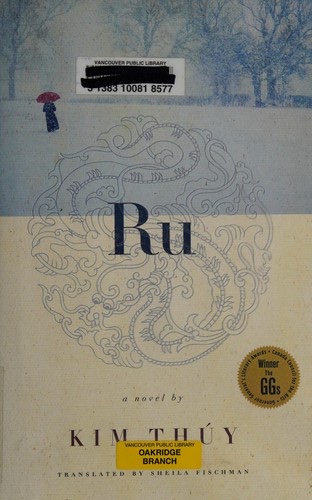
Cover of Ru

Ru

Kim Thúy

4 ideas

  1. Saigon heiress becomes Granby boat refugee

    Nguyen An Tinh, born in Saigon during the 1968 Tet Offensive into a wealthy family, flees Vietnam by boat with her family as a ten-year-old after 1975. She is crammed in the hold, then held in a Malaysian refugee camp, and is finally resettled in Granby, Québec, where sponsors and local teachers help her rebuild. Her family's former status is erased, and her parents, once privileged, take menial work so their children can start over.

  2. Ru as both lullaby and stream

    The title works in two languages at once. In French, 'ru' is a small stream or flow, such as of tears or blood. In Vietnamese it means a lullaby or to lull. The concept holds that displacement's trauma and its consolation run through the same channel, so memory of catastrophe can be carried in a soothing, rocking voice rather than as open wound.

  3. The returnee is foreign in both homelands

    When the narrator goes back to Vietnam as an adult, locals see her as an outsider. In Québec she remains visibly Vietnamese. The lens shows that migration rewrites the body and bearing, not just the passport, so the emigrant cannot simply return to the origin they left.

  4. Fragments as the true shape of displaced memory

    The novel is told in short vignettes, and each one links to the next through an image, object or word rather than through chronology. The lens holds that a life broken by flight is remembered by association, not in sequence. A smell or a phrase can jump the mind from a Saigon villa to a Granby classroom, so a fragmented form is more faithful to such a life than continuous narration.

Save and mark ideas in the app