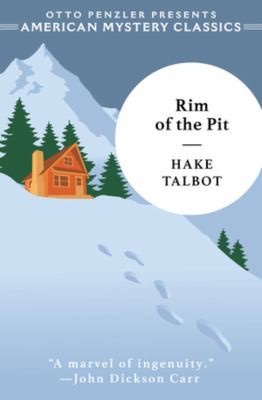
Cover of Rim of the Pit

Rim of the Pit

Hake Talbot

4 ideas

  1. Séance and printless tracks at snowbound lodge

    In a snowbound lodge in the northern woods, a household holds a séance to consult a dead man, Grimaud Désanat, whose wishes still bind a decision over his estate's timberland. Afterward come apparent possession, invocations of the windigo legend, a death, and marks in the snow that begin and end without any approaching or departing footprints.

  2. Investigate impossibility as a magician would

    Someone trained in conjuring and card-sharping reads an apparent impossibility as proof of a method, not a mystery of nature. The key question shifts from 'how could this happen?' to 'what was the audience induced to assume, and where was their attention steered?' This finds a hidden mechanism by locating the false premise the witnesses supplied themselves.

  3. Supernatural framing as camouflage for mechanism

    A ghost story or folk legend, such as a dead man's lingering will or a windigo that walks on air, primes witnesses to fit physical anomalies into an uncanny narrative. Once people accept the frame, they stop checking the mundane details that would expose a trick. The legend works as cover, and it is most effective in an isolated setting where no outside skeptic can reset the frame.

  4. Missing traces are evidence, not absence

    An unmarked expanse of snow is a hard physical record: it fixes what could and could not have crossed it, and when. An apparent impossibility therefore narrows the solution space sharply, because the true method has to satisfy the constraint exactly. The error almost always lies in an unexamined assumption about timing, sequence, or who observed what, not in the physical evidence.

Save and mark ideas in the app