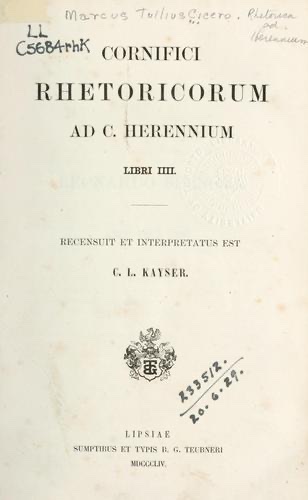
Cover of Rhetorica ad Herennium

Rhetorica ad Herennium

Cicero

3 ideas

  1. Rules for building reliable memory backgrounds

    Memory is split into loci (backgrounds, such as rooms or intercolumniations in a familiar building) and imagines (images placed on them), so that the order of places preserves the order of items. Good loci are deserted, distinct from one another, moderately lit, of medium size, and spaced about thirty feet apart. Every fifth locus gets a distinctive mark, such as a golden hand, so you can enter the series at any point and move forward or backward.

  2. Active images outlast ordinary ones in memory

    The mind passes over the ordinary but retains what is novel, base, dishonorable, unusual, or great. Imagines agentes exploit this. You make each memory image act: exaggerated beauty or ugliness, bloodstains, crowns, comic distortion. An unexceptional image fades, so you engineer strikingness on purpose.

  3. Trained artificial memory strengthens natural memory

    Natural memory is innate. Artificial memory is a learned discipline of places and images. Art is worthless without natural ability, and natural ability improves greatly with method. The handbook separates memory for things, where one image stands for a whole idea, from memory for words, where images encode each term. Memory for things is more practical, and memory for words is harder training that makes it easier.

Save and mark ideas in the app