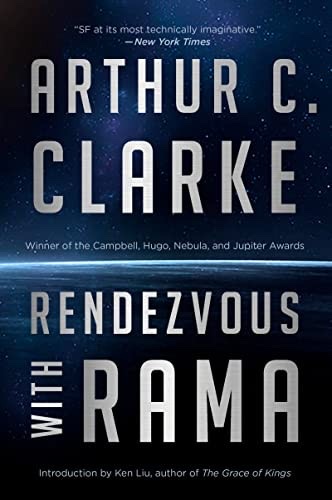
Cover of Rendezvous with Rama

Rendezvous with Rama

Arthur C. Clarke

4 ideas

  1. The Endeavour's exploration of Rama

    In 2131 Commander Bill Norton's survey ship Endeavour intercepts Rama, a 50-by-20-km spinning cylinder. The crew enters it, finds an interior world lit by artificial suns and split by a Cylindrical Sea with an island they call New York, and meets 'biots', robot-like creatures that ignore them. The Mercury colonists, fearing the object, launch a nuclear missile at it, which crewman Boris Rodrigo disarms. Rama then swings close to the Sun and departs the Solar System, having taken no notice of humanity and leaving the crew with more questions than answers.

  2. Indifference as the deepest cosmic shock

    The most humbling encounter with a superior intelligence is not hostility but being ignored. Hostility would confirm that humans matter enough to threaten or be threatened. An object that passes through our territory on its own business, without registering our presence, removes humanity from the centre of the story entirely.

  3. Inferring designers from their redundancy patterns

    The crew never sees the builders, so they learn about them from the design itself. Seeing systems repeatedly built in triplicate, they conclude that 'the Ramans do everything in threes'. When the makers are absent, their habits of engineering redundancy become the most reliable evidence of how they think and what they expect to go wrong.

  4. Catastrophe precedes institutional vigilance

    Humanity builds the Spaceguard asteroid-detection system only after a 2077 meteorite destroys cities in northern Italy, although the risk had always been known. Societies fund protection against rare, high-impact threats only once one has struck. It is that belated system that makes it possible to detect Rama at all.

Save and mark ideas in the app