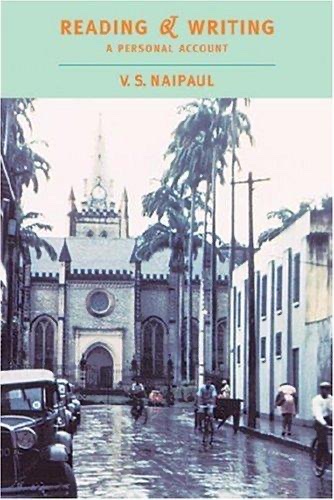
Cover of Reading and Writing: A Personal Account

Reading and Writing: A Personal Account

4 ideas

Buy on Amazon
  1. Inherited literary forms distort colonial self-perception

    A writer raised on imported literature inherits ways of seeing that do not fit his own society, so he first perceives his world as deficient or unreal because it fails to match the borrowed material. Learning to write means slowly discarding those inherited forms until the local matter can be seen and recorded on its own terms.

  2. The father reading aloud fragments at home

    Naipaul recalls his father reading him passages from English books (including Dickens and Shakespeare) in Trinidad, choosing bright isolated scenes rather than whole works, so the boy absorbed literature as detached, glowing fragments. This piecemeal exposure, divorced from narrative context, shaped how he initially understood what books were and what they were for.

  3. Reading backward to locate the writer's ground

    Naipaul reads an author by reconstructing the material and social world that made the writing possible, asking what a writer could know and assume rather than only what the text says. Seen this way, the absence of a usable literary tradition becomes the central fact a colonial writer must work out rather than a mere background condition.

  4. Writing as sequential layering of understanding

    Naipaul describes his development as a series of distinct stages, each book adding a layer of comprehension that the previous one had made possible but could not itself reach. Understanding of self and origin is cumulative and retrospective: earlier work is only fully legible once later work has supplied the missing context.

Save ideas and give them a thumbs up or down in the app