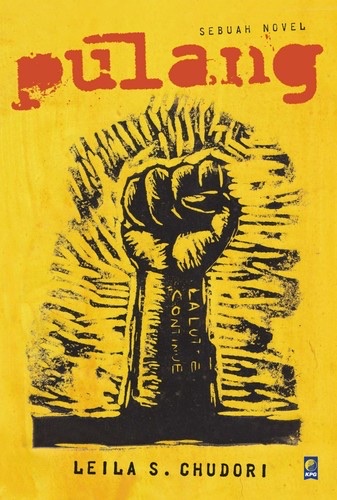
Cover of Pulang

Pulang

Leila S. Chudori

4 ideas

  1. Four exiled journalists open a Paris restaurant

    Journalist Dimas Suryo and colleagues were abroad at a conference in Santiago when the 30 September 1965 events began, and Suharto's New Order revoked their passports. Dimas, Nugroho, Risjaf and Tjai drifted through Havana and Peking before settling in Paris, where in the early 1980s they opened the cooperative Restoran Tanah Air ('Homeland Restaurant'). Decades later Dimas's French-Indonesian daughter Lintang goes to Jakarta in May 1998 to film survivors' families and is there for the riots and Suharto's fall. Dimas had kept jars of turmeric and cloves and asked to be buried in Jakarta's Karet cemetery; he returns only in death.

  2. Bersih lingkungan: guilt inherited through bloodline

    Under the New Order, 'clean environment' screening barred relatives of alleged communists from the civil service, universities and ordinary respectability. Some former political prisoners also carried an 'ET' (ex-political prisoner) mark on their identity cards. Punishment attaches to kinship and association rather than to acts, so a purge keeps producing new victims a generation after the killings. Children like Hananto's son Alam grow up paying for a father's affiliations, and the stigma, not the violence, becomes the regime's lasting instrument of control.

  3. Cooking as a portable, defiant homeland

    When a state strips exiles of passports and the right to return, recreating its cuisine becomes a way to hold citizenship in a nation that has disowned them. The restaurant is both livelihood and political statement, a place where the exiled version of Indonesia keeps existing. Because it is visible, the regime's embassy tries to pressure and discredit it. Reading food as a territory, rather than a comfort, shows why diasporas fight so hard over recipes, spices and places to gather.

  4. The second generation becomes history's witness

    Lintang, raised in Paris with no memory of 1965, can ask the questions that silence and fear have blocked for survivors inside Indonesia. Her outsider status and documentary camera turn inherited trauma into testimony.

Save and mark ideas in the app