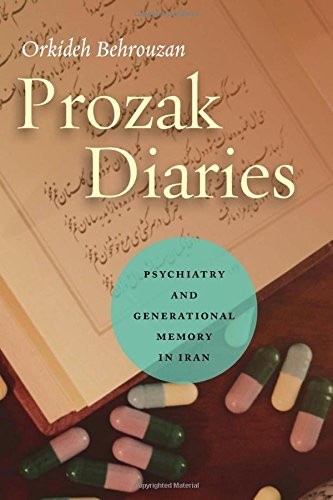
Cover of Prozak Diaries

Prozak Diaries

Orkideh Behrouzan

6 ideas

  1. Psychiatric discourse as a shared social idiom

    Diagnostic terms like depression and 'prozak' circulate in everyday speech not only as medical categories but as a vernacular for talking about grief, frustration and social malaise that otherwise lacks a sanctioned vocabulary. Adopting the clinical term lets people name collective suffering indirectly, turning a private diagnosis into a public commentary.

  2. The 1980s generation as a Dahe-ye Shasti cohort

    People who were children during the revolution and the Iran-Iraq war came to recognize themselves as a generation through shared memories of air raids, school rituals, martyrdom imagery and household silences. The generational label is built retrospectively, and psychiatric language becomes one of the main tools through which the cohort narrates what that childhood did to them.

  3. Depression talk carries unspoken historical loss

    Invoking depression in post-war Iran often works as a displaced way of speaking about war trauma, political disappointment and unmourned deaths that cannot be addressed directly. The symptom vocabulary stands in for a history that is officially narrated as heroic sacrifice, so clinical language becomes a channel for counter-memory.

  4. Pharmaceuticals as cultural objects, not just drugs

    Antidepressants gather meaning beyond their pharmacology: they mark modernity, self-care, class and a willingness to name inner states, and they spread through word of mouth, jokes and informal self-prescription. Studying a medication's social life shows how a society negotiates selfhood, not only how it treats illness.

  5. Medicalization can be empowering rather than depoliticizing

    Critiques of medicalization usually say that labeling distress as individual pathology hides its social causes. In this setting, psychiatric labels instead opened room to talk about suffering, legitimized emotional life and let people criticize conditions obliquely, so medicalization worked as a local form of agency and not simply as imposed Western categories.

  6. Belatedness in naming generational trauma

    Childhood experiences of war and upheaval are often lived as normal at the time and only reinterpreted as damage years later, once a vocabulary like depression or trauma becomes available. Distress is therefore coproduced by past events and the later language that makes them legible, and memory is actively reworked through present categories.

Save and mark ideas in the app